How Interviews Are Evaluated
When evaluating you with the use of a scorecard
An interview scorecard, also referred to as a rating card or scoresheet, is a tool that interviewers use to help them assess a candidate’s eligibility for a position by applying a standardized scoring metric that helps them evaluate their candidate’s responses. Most structured interview formats will involve the use of either a formal scorecard or some form of basic note sheet, and they allow companies to evaluate candidates in a fair and consistent way, providing a more objective and analytical method for them to make hiring decisions
With the use of a scorecard
Where implementing an evaluation system that involves the use of a scorecard, it means the employer or recruitment agency in question has elected to retain a greater degree of control over the candidate selection process by standardizing the evaluation metric with the use of a scorecard. While the interviewer still retains a large degree of control in the decision-making process, as this assessment is not solely determined at their own discretion, it means the employer is not entirely relying upon and trusting the judgement of the interviewer when it comes to the evaluation of the candidates themselves
For this reason, they will be instructed beforehand on how much to factor the scorecard into their overall decision making, and will be given guidance as to how much latitude they have to make this determination based on their own impressions. This will vary from employer to employer and from role to role, and your interviewer is expected to follow these instructions accordingly
‘Interviews where scorecards are used are typically conducted using structured interview formats. This is because they give the interviewer the best possible format to ask questions and assess your responses against a set list of questions with the use of a structured metric’
Whether a scorecard is utilised or not, the interview will still be put together in exactly the same way. First, an interviewing framework will need to be comprised. As was shown above, this starts with a list of traits and qualities the employer feels it’s necessary for their ideal candidate to have. These will normally be broken down into essential and desired categories. Essential skills and experience are always essential for performing the role, whereas desirable skills and experience can normally be learned on the job. If well written, some, or all of these will be listed in the job description, so pay close attention to it. The interviewer will be instructed to look for evidence of these essential and desired traits and experience, like so
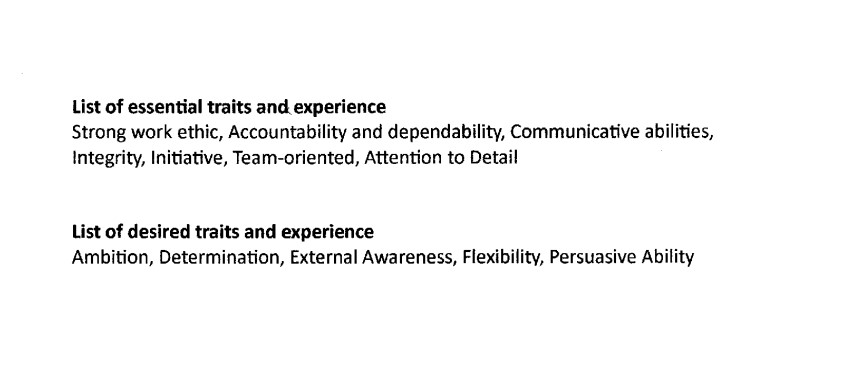
The interviewer will need to review these criteria and be fully familiar with them before their first round of interviews commences
At its most basic level, a scorecard serves as a valuable tool that can be used to filter down candidates before the final candidate selection. Keeping in mind your interviewer has to validate any hiring decisions they make, if you don’t score high on a scorecard, it means you won’t be in contention when the interviewer makes their final selection once the interviews are concluded. As explained above, scorecards will be used in conjunction with the interviewer’s own assessment to varying extents when it comes to the hiring recommendations and decisions they make, and while some interviewers will be instructed to stick to their scorecards rigidly, others will be given more leeway when it comes to using their own professional judgement in the hiring decisions they make
There are several benefits scorecards can offer an employer
- For starters, they can help an interviewer stay on track, not only enabling them to evaluate the right areas in each of their candidate’s responses, but also helping to ensure they ask each question in its proper sequential order. Moreover, they can help keep the ratings system consistent for each candidate too. In that with a standardized scoring metric to base their evaluation on, they’re regarded as an effective tool to help keep the interviewer’s assessment objective and remove any biases or predispositions. (Although this is touted as one of the main benefits of an interview scorecard, it is only partly true. That’s because no matter what evaluation system is that’s used, the interviewer will always need to factor their own judgment into any hiring decisions and recommendations they make to one extent or another)
- They are also quite useful for an interviewer when it’s a close call between two qualified candidates, with a scorecard sometimes being used as the determining factor when an interviewer is having a hard time choosing between them
- Another big advantage they give interviewers is that they are great when it comes to collaboration too. That’s because scorecards help interviewers more easily compare notes with each other, which can be especially useful in a candidate selection process where multiple interviews or panel interviews are involved. Particularly where multiple interviews are concerned, they can help those involved in the recruitment process keep track of each candidate, and they allow interviewers and recruiters to more easily recall the specifics of each interview and how it went. That’s because scorecards can be uploaded onto an application tracking system and be reviewed as needed. On top of this, it also helps interviewers explain their recommendations to hiring managers and employers too…
- Lastly, whether for legal or administrative purposes, scorecards not only provide a paper trail which can be essential for organisations to refer back to at later points in time, but they also help the employers who use them to feel more confident about the criteria they are using to evaluate their candidates on, and in particular, when it comes to employers and hiring managers, more in control about the decisions and recommendations their interviewers are using to base their hiring decisions around in general. While many scorecards can be purchased prewritten beforehand, like interviews themselves, employers can often put together their own ones too. When doing so, most companies will often include hiring managers, interviewers, and other people in senior management roles within the organisation to collaborate on building ones that best match their specific needs
In spite of the many clear advantages they can offer, candidate evaluations involving the use of formal scorecards are a less commonly found method of interviewing in the recruitment industry today, and there are several reasons for this
One of the main perceived drawbacks for employers and recruiters is that scorecards only allow interviewers to score against a particular set of criteria, as such, it means there could be many other areas your interviewer might be missing when evaluating your answers
If an interviewer has to divert their attention between a scorecard and a candidate, there can be reduced eye contact and engagement between the two, leading to a poorer overall interviewing experience, which is another drawback employers and recruiters are keenly aware of. Moreover, when the interviewer is taking notes and writing down things in response to every answer you give it normally makes candidates more nervous in an already tense situation. It’s this last factor that most experts feel leads to a poorer interview experience overall, that’s why within the recruitment industry today, it’s generally regarded that by making the candidate more tense and nervous it inhibits an interviewers ability to get a proper evaluation of them, meaning they won’t be able to see the best side of you, which is the main reason why the use of formal scorecards is a less common form of evaluation within the recruitment industry today – although in their place, more informal note sheets are usually retained by many interviewers instead

In order to understand scorecards better, it’s necessary to see how they look
This is important because candidates very rarely get to see what the interviewer is scoring them on. That’s why next, we will examine what scorecards look like and what they are comprised of:
An interview scoring sheet typically includes the following
• A consistent rating system
• Specific criteria aimed at evaluating a candidate’s skills, traits, qualifications, and experience
• A comments section
• A “total score” section
When considering the different types of ratings that might be employed, the first thing to remember is that as a candidate there is no way of knowing what scoring system your interviewer will be using unless they specifically tell you before the interview itself. As such, while what we examine here will be somewhat academic, as a candidate it can be still very useful to understand how your interviewer can potentially score your responses. When it comes to the rating systems themselves, there is no such thing as a right or wrong one, it simply comes down to the way the employer or HR consultancy firm in question feels it’s best to evaluate you based on the role and the types of questions they’ve complied your interview with. There are a few different ratings systems that your interviewer might employ, these are examined below:

The Points based system
The points-based system uses a metric based on a 1 – 5 or 1 – 10 scale. With 1 being the lowest, 10 being the highest, and all other integers on this scale inbetween. With a points-based system, it means your answers are assessed along the lines of a gradient, as such, not only will your interviewer look for more from your answers than they would with other types of rating systems, but it can sometimes be difficult to know what the best answers are because the integers between the highest and lowest scores may be interpreted differently by different interviewers, that’s why with this system how you structure your answers is very important. At the end of the interview, your interviewer will normally add up the all scores from each question to give them an overall total and use this as a guideline to determine how suitable you might be for the role
The Ranking based system
A variation on the points-based system is one where your answers are ranked on an order from Low – medium – high – exceeding. With this type of system, your answers are ascribed to one of these categories, which typically means the interviewer will be looking for you to cover specific things in each response and ascribe these a given ranking depending on how much you cover accordingly. Like the points based system, the most important thing with this system is to give responses that are thorough and well structured
The Pass/fail system
The pass/ fail system is a more basic type of ratings system. As the name implies, there are only two options for the interviewer to either pass or fail each response that you give. This makes it a more black and white type of ratings system and it’s typically why employers only use it where hiring multiple applicants, normally for menial positions within an organisation that require a very specific quality or skillset. While the strength of your answers will still have an impact on the interviewer’s overall assessment, with a pass/ fail system, the interviewer will be instructed to assess very specific things in your responses to each question. At the end, the interviewer will usually tally up all the passes on your scoresheet and in conjunction with the notes they have taken, will use this to determine your overall suitability for the role
INTERVIEW PROFESSIONAL is now proud to present you with a unique insight into how your interview is scored and evaluated. Here, you will see what a scorecard looks like, and how it is used by your interviewer to assess your responses
Note. Examples given here will vary over different occupations and industries
Here you can see how the scorecard is structured, and below you can see the sort of notes that the interviewer writes on the scorecard when evaluating you
Commitment and Aspirations – Answer
‘I’ve wanted to be a real estate agent ever since I attended my first career fair in high school. When I was growing up, we didn’t really have a permanent home, that’s why owning one is something I’ve always appreciated. It’s also why, when standing in that booth at the career fair, when I asked what an estate agent does, from the moment I got the answer, my mind was made up, and from that point onwards, it’s what I’ve wanted to do ever since’.
‘I want to work for you because home ownership is something I believe in, that’s why I also want to help others achieve this important life endeavour, and it’s why I’ve worked tirelessly both in my professional and academic life to get to the place I am today so I can accomplish this. I don’t just want a job, I want a career, and I’ve applied with your organisation because I believe I can make a difference for you. It’s always been my ambition to work for a large prestigious agency like yourselves, and having researched your organisation before I made this application, after being voted best real estate agency 3 years in a row, I believe that if I’m given this opportunity I can repay it with the kind of sales and success you deserve. I’ve also thought a lot about what I’d like from my career too, and not only am I ready to put in the hard work and commitment required to make the most of this role, but within 5 years, I want to have worked my way up within your organisation through strong sales and proactive team collaboration to a managerial position so that I can contribute to your organisations continued success in an even more meaningful way’.
Note. Examples given here will vary over different occupations and industries
Background and qualifications – Answer
‘There are numerous things that I believe make me highly qualified for this role. Aside from the passion and love I have for the field of real estate itself, I believe I am also well academically qualified for this role too. While I don’t have an official degree, I enjoyed high school immensely and finished it with above average grades, scoring really well on maths and English in particular, where I achieved A and B grades respectively. On top of this, I have a strong employment background in this field, and since I left school, most of my employment has been based in this field’.
‘I started my career working in inventory control for XYZ company, this required a hands-on approach and close attention to detail, and while not directly related to real estate, I nevertheless gained many important skills that have helped me since as my career has progressed. Most notably the ability to record details precisely and to check all my work thoroughly. I’d had 2 ½ great years with XYZ, but I really wanted to get into the field I’ve always had a passion for, which is real estate. I was delighted when my persistence finally paid off and I got my chance with Best Property Management. In the 6 years I’ve been there, I have worked my way up from an office assistant to being one of the entrusted members of the property management team. As such, many of the duties I now perform are very closely linked to the duties described in this role, and for the last 18 months I have been liaising with interested parties, ensuring properties are presentable and ready for viewing, liaising with various external companies such as landscapers, cleaners, and energy suppliers at the request of our clients to ensure regular property upkeep, showing interested parties around available rental properties and providing information on each one as required, on top of other administrative duties such as collecting rent and following up with tenants on late arrears.
Furthermore, I am a strong believer in continuous improvement, and I have recently completed an LSE certification in real estate within the last 12 months. Having this certification has allowed me to gain a better understanding of property prices and fluctuations within the market, and has also allowed me to better analyse and understand the financing decisions my prospective clients might make when it comes to assessing their ability to pay rent, enabling me to do my job more effectively, and I believe this will be a valuable tool should I land this role too’.
‘I would like to end this answer by saying that furthering my education is something that is highly important to me, and I am always willing to spend the time and effort it takes to learn new skills if it helps me better perform my role and will always take a proactive approach when it comes to this’.
Note. Examples given here will vary over different occupations and industries
Hard and Job-related skills, experience, and knowledge – Answer
‘In my previous role serving the community for a non-profit organization, I was part of a team responsible for the allocation and management of research grants within my geographic region of the country. As such, it was my responsibility to assess and approve grant funding to eligible organisation’s involved with the development of new treatments and medicines, from the initial research stages all the way through to the end of the clinical trial process. My duties included not only the implementation of proposed completion funding timelines, but also involved assessing the proposed deliverables and the viability of the research proposals themselves. The other main overriding aspect of my role involved me budgeting so my team and I could allocate over 15 million in research grant allocations each year accordingly. I believe it was the effective relationships that I was able to develop with my clients, along with the clever way I utilised policy guidelines where assessing clinical trial grant applications, that helped me to make well-balanced and objective decisions so I could budget the grant resource allocations that I was responsible for accordingly. Because of this, it enabled me to administer grants to more than 12 promising organizations than our team had managed to do the year before. Of these, 7 went on to reach the clinical trial stage, and 5 went on to be approved over the next 18 months. This equated to a 58% percent success rate, which was 47% percent above the industry average. By using clever and pragmatic budgeting principles, I had stretched our grant allocations out over a longer period of time, ensured that deliverables were exceeded, and empowered more organisations looking to make a difference within the scientific landscape, enabling our enterprise to continue its mission of making a healthier, safer world’.
Note. Examples given here will vary over different occupations and industries
Hard and Job-related skills, experience, and knowledge – Answer
Situation
‘The situation was that I was responsible for supervising a team of 6 working on a busy supermarket floor. In addition to making sure the shelves looked great and were fully stocked, we also had other important duties such as ensuring our section was clean and obstacle free, as well as assisting shoppers with their queries, and we were kept really busy on a day-to-day basis. On top of this, we had just started a brand-new home delivery service, and while this was great news, we were informed the scope of our duties would be increasing and that we would be responsible for preparing and packing orders from then on too, but some in my team weren’t happy with this’.
Task
‘It was not only my task to ensure our section of the supermarket looked great at all times, but to ensure that my team was able and motivated to perform their duties to the best of their abilities at all times too’.
Action
‘I always perform my duties first and foremost by leading by example. That’s why, as a supervisor, the actions I took involved me working hard to ensure our section of the supermarket floor looked great every day, ensuring the shelves were fully stacked, and always being on hand to assist our customers with any queries they might have, as well as making a point of always being punctual and on time. What was equally important though was the effective relationships I was able to build with each member on my team. By making a point of asking how everyone was each day, and by always taking the time to have a good laugh and conversation with everyone whenever I could, it enabled me to reassure them that we could perform the new duties we’d been given, and made everyone want to try and do their best to achieve this’.
Result
‘Just as I knew they would, the result was that my team stepped up to the challenge, and they soon adapted to their new duties like it was second nature. After the first month, they’d stopped griping completely. By the end of the second month, we’d all grown so accustomed to these new duties, myself included, that we found it provided a new and pleasant diversion from the rest of our responsibilities, making the job even more fun and enjoyable’.
Note. Examples given here will vary over different occupations and industries
Hard and Job-related skills, experience, and knowledge – Answer
Situation
‘In my role as a project co-ordinator, whenever beginning a new project, we would always start off by reviewing our client’s request. Once the full scope of the project became clear, we would regularly bring in designers and other external parties who would then work with us to help bring our clients vision to life. One of the biggest challenges in this situation when trying to bring all of these various elements together was ensuring everyone delivered to the timescales that were initially agreed upon’.
Task
‘The task I would often face in my role would be trying to coordinate all of the people, departments, and external organisations involved in a given project so that it could be implemented within the timescales specified by the client. This was particularly problematic when one party didn’t deliver, because sometimes this would hold the project up, and other parts of it couldn’t be completed until that thing was done’.
Action
‘As I gathered experience in my role, I discovered the best way to deal with this problem was through effective communication. In the first instance, this meant effectively communicating with everyone involved in my project, making sure they were all clear on their tasks and on the timescales involved, and to this end, being concise was really important. That’s why the actions I took always involved me outlining everyone’s tasks and timeframes in the form of a detailed list of bullet points and disseminating this on an email to everyone. This was something that I found went a long way to helping mitigate any problems should they arise. Another important thing I’ve found is that following up with people, especially external parties, is also very important, and I made a point of insisting on regular updates from everyone involved. It’s also why another action I take whenever I start on a project is to compile a calendar list, and on it write down everyone who’ll be involved in it with me. I then colour code it to distinguish between the essential and important project areas. This not only allows me to identify each part of the timeline and its completion date, but also the points at which updates are expected. I’ve found it’s a great way of helping me keep track of how each part of my project is progressing, and allows me to have visibility if something needs to be amended along the way. Keeping clear lines of communication works both ways, that’s why lastly, I always ensure I’m easily accessible if someone needs to contact me, and I make a point of always responding quickly whenever someone contacts me whether it’s by phone or email, or any other method’.
Result
‘The result of this approach is that I’ve found it’s enabled my projects to run a lot more smoothly, and consequentially, I’ve been able to attain a higher degree of success when it comes to finishing projects within the initially specified timeframes. Furthermore, the feedback I’ve received from clients following the surveys that have been returned to me upon numerous successful project completions have also indicated both to myself and my employer that the methods I utilise are highly effective – making the overall journey more seamless not just for my clients, but for all project members and external organisation’s involved, from inception all the way to completion of the project itself’.
Note. Examples given here will vary over different occupations and industries
Individual traits and qualities – Answer
‘It would depend on the specific circumstances involved. Work is one of the most important facets of my life, and I would always like to think I would be on hand when my employer needs me the most. With that being said, my family means everything to me. Therefore, if there was a situation where I needed to prioritise my work over an emergency family situation, I’d need to be 100% certain they were in capable hands and well taken care off. In such a circumstance, I’d be happy answering that I would be willing to make being there for my employer my number 1 priority’.
Note. Examples given here will vary over different occupations and industries
Individual traits and qualities – Answer
Situation
‘The situation was that we were implementing a new online payment system on behalf of a client. I’d talked with them at length before I began the job, so I knew exactly what they were looking for. They wanted something that was easy and intuitive for their customers to use, and that also had a striking visual element to it too’.
Task
‘My task was to deliver the first-rate work that my customer was expecting on this project, while also meeting the demanding quotas set by our creative director for the completion of my other valued projects that I was also managing within my caseload too’.
Action
‘During the initial phases, instead of doing the work on a site builder, I quickly realised I could take actions that would’ve allowed me to go about implementing the project with the judicious use of programming code, this would’ve saved me a lot of time and still fallen within the parameters of the specifications for the contract we’d agreed. However, such implementation would’ve resulted in a longer end-user process, and would not have had the same visual effect my client was looking for. That’s why I didn’t hesitate to do the job on the site builder, even although it was more the difficult option, because I want the best for my clients, and I’m not satisfied unless I do each and every job to the best of my ability’.
Result
‘The result was that by acting with integrity, it not only brought me a higher degree of personal satisfaction when I completed the job, but I was also able to build a more effective relationship with my client over the course of the project too. More than this though, it ensured I received great feedback once the work was completed, which reflected well not only on myself, but on my company too, and because I’d taken the time to do the job right the first time, it also meant I didn’t have to go back and spend more costly time redoing anything because our client was already completely satisfied’.
Note. Examples given here will vary over different occupations and industries
Individual traits and qualities – Answer
Situation
‘Teamwork means several things to me. First and foremost, it means being there for my colleagues when they need me most. Equally important, it also means working together with my colleagues to overcome the challenges we encounter both when it comes to our customers as well as anything else we might face. Lastly, teamwork means having fun and great shared moments too…to give you an example. There was a situation where I noticed a colleague was struggling with something they were working on, so without being asked, I went over and offered my assistance’.
Task
‘When they explained what the problem was, I realised it was something very simple indeed. The task they were trying to perform was to bill a customer’s account, but it wouldn’t let them. They were really stressing over this and trying frantically to figure out why it wouldn’t bill’.
Action
‘I took action by pointing out that before any billing function could be performed, the bill itself had to be released first. This would allow the system to gather all the information necessary to generate the bill, and would then send the bill out to the customer upon completion. I pointed out the icon at the top right-hand corner of the screen that was used to do this’.
Result
‘My colleague was delighted, and the result was that they managed to get the task completed without any more difficulty. Not only was it very satisfying to be able to help in this way, but it also meant I got to know my colleague better too, and we soon built up a really good working relationship. This was just one of the many things that helped contribute to the great team atmosphere I experienced whenever I went into the workplace’.
Note. Examples given here will vary over different occupations and industries
Candidate Alignment – Answer
‘When it comes to personal goals, knowing what I want to achieve is always at the forefront of any targets I set. This starts with me sitting down and thinking about what I want to achieve and why. From there, I’ll gather as much information about my goal as possible. To this end, there is an acronym I often use to help me plan this out. This is the S.M.A.R.T acronym which stands for Specific, Measurable, Achievable, Relevant, Timely. This not only gives me a great way to structure my actions, but also helps me decide on a realistic timeframe in which to achieve them too. From there, all I need to do is preserve until my goal is achieved’.
‘I believe reaching any goal means you need to be methodical and organised, that’s why, for professional and career orientated goals, in addition to using the smart acronym, I always use my personal development plan (PDP). I’ve not only found this is a great way to help me map out my longer-term career objectives, but is also a highly effective way for me to plan and structure the shorter-term steps I can take to achieve these too! My PDP provides additional motivation when I need it most, and it gives me a path to follow, which is not only great for myself, but also allows my supervisors to see the progress I’m making too’.
Situation
‘I have a great example I can share with you of a situation when I used my personal development plan to great effect’.
Task
‘I wanted to progress in my last role, so the task I set out on my PDP was to move into a role with more supervisory responsibility within my department over the next 18 months. With this goal in mind, I then considered the specifics of how I would go about achieving this’.
Action
‘The actions I set out on my PDP involved several smaller steps, such as maintaining my highly impressive metrics, and looking for opportunities whenever I could to get more involved in the workplace. Having the right qualifications is very important for career progression too, that’s why, the biggest goal I set out on my PDP was to complete a college night course. To help me do this, I set several sub-actions on my PDP that included outlining what I wanted to achieve with my qualification, mapping out the time commitments involved and planning out how I would use my time most effectively to mitigate the impact on my work/ life balance, alongside identifying potential internal roles I could apply for once I had the qualification. Part of these actions also involved me researching the qualification, which is how I learned that people with it in my industry are around 32% percent more likely to end up in managerial roles than those without. Taking these actions made a huge difference and gave me the confidence to take the plunge and commit myself to the night classes’.
Result
‘The result was that in the end, it was everything I expected and more. I finished the course and got the qualification I wanted, then a few months later I applied for a new role within the company, and was delighted when I landed it and got the increased authority I was looking for. Having the PDP there at my side was a great help, and not only provided me with increased motivation when I needed it the most, but also helped me chart my progress every step of the way’.
Note. Examples given here will vary over different occupations and industries
Candidate Alignment – Answer
Situation
‘There was a situation where a client was contacting us back after recently speaking with another one of my colleagues. My colleague had advised them they would resolve an outstanding issue on their account, but this had not been done. As they’d already spent a lot of time talking with the client and were familiar with their issue, the best practice was to send the account back to them to deal with, then have them contact the client back with a resolution. However, when I sent the details on, I got an angry response back saying it wasn’t their responsibility, which left the client in limbo, and meant I would have to get back to the client myself as my colleague was refusing to do so’.
Task
‘My task was to resolve this dispute with my colleague so our client could get the level of service they deserved’.
Action
‘While the most important thing was getting the issue resolved and I didn’t mind following up with the client myself, I was very familiar with our company processes and knew I was in the right. I also knew it would also be a much more seamless experience for the client if my colleague did what they’d promised, rather than have to explain the whole situation to myself again. That’s why I took action by emailing them with a screenshot of the section in the policy guidelines that covered this particular scenario, and tactfully pointed out that in this specific circumstance, it was their responsibility to do what they had promised and contact the client back’.
Result
‘The result was that I received an email back an hour later not only apologising, but saying that they had already contacted the client back, and would have a resolution for them by the end of the day’.
Note. Examples given here will vary over different occupations and industries
Next, we see the closing sections of the scorecard. These will contain the final instructions for your interviewer
Lastly, the interviewer will score the candidate