Interview Professional’s Guide to composing a great C.V or Resume
While the structure of the C.V or resume can vary by country, industry, individual preference, or simply by the layout and design of the document itself, there are conventions for structuring them that are almost always universally adhered to. As such, you will normally see certain sections in a C.V or resume that are considered to be standard, and we will examine these sections in more detail just now
WHAT ARE C.V’s and RESUMES?
Select the link below to learn more about C.Vs and Resumes
What are C.Vs and resumes – How to compose a great one, an outline of their standard structures
LISTING WORK ENTRIES IF YOU ARE A PERSON WITH LITTLE WORK EXPERIENCE
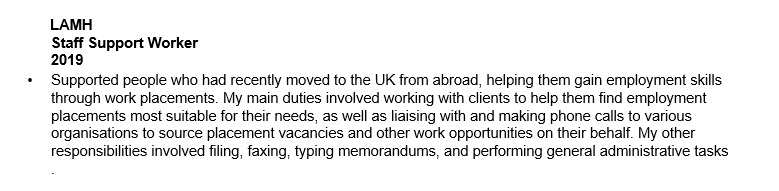
If you have little in the way of actual work experience, it can be harder to compose an effective C.V or resume. However, there are 1 or 2 tactics you have at your disposal that can help. For starters, if you have a job listing that only lasted a few months, a clever tactic that can sometimes bolster your chances is to list a year instead of a month, so the date is simply the year itself, like so
Or, if you worked for an organisation twice, both for short periods of time, once in June 2019, and once in 2022, instead of writing the month and year, simply list both dates as years, like so
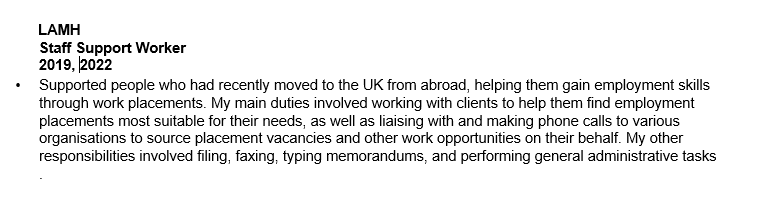
Remember this is only a short term solution to get you into the next stage of the candidate selection process. If asked directly, it is important you are upfront and clear about the dates involved on your C.V or Resume
GUIDANCE ON WRITING A C.V OR RESUME IF YOU HAVE LITTLE OR NO EXPEREINCE
Firstly, honesty is the best policy – because employers can always check your employment background and get references to build a true picture of your work history and experience
With that said, from a hirer’s perspective saying you’re unemployed – or having a resume that clearly indicates you’ve been out of work for a while looks bad, and employers will tend to overlook these types of documents

Coming out and simply saying that we’ve been unemployed for a certain number of months or years will always seem bad in the eyes of any hirer, (that’s because there are certain things they are responsible for looking for when making hiring decisions, and an established employment history is usually one of them!)
Therefore, we need to be truthful, while at the same time not driving the employers and recruiters who view our applications away – instead convincing them that we have the necessary qualities they are looking for
In this regard then, if we lack an established or regular work history, instead of merely saying, I’ve been out of work for 7 months, or 7 years, we need to consider how best to deal with this crucial detail on our C.V – and when we consider how limited our options for doing this are, we should come to the realisation that our best approach is to put a spin on why we’ve been out of work for so long
Maybe you have a hobby, cause, pursuit, have been a carer for someone, or maybe you really wanted to get back into higher education and have prioritised this over looking for employment while you tried to get onto a course. Maybe you wanted to pursue art or write a book. Listing your current position as ‘self-employed’ can potentially be another means you have at your disposal too. Whatever the reason, if you can come up with something that sounds credible, all you need to do is be able to talk about this confidently. If your reason sounds credible, you will instantly become a much more viable candidate in the eyes of an employer. What works about this approach is that a personal background or individual rationale is not something that can be readily checked up upon or verified. Therefore, if you’re able to tell a story that has a viable basis to it, then it becomes a superb way to explain long and damaging gaps in your work history, and, while an employer may still be concerned with your work history (or lack thereof), a convincing reason as to why you’ve not been able to find suitable employment over a given length of time will certainly go a long way to convincing an employer that you’re a worthwhile candidate for the role
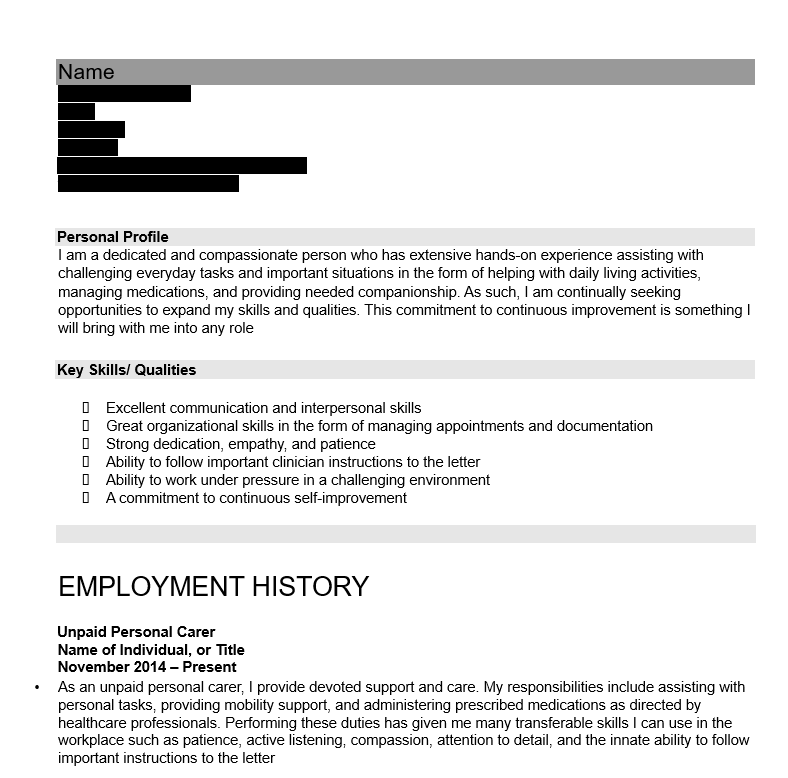
STRUCTURING YOUR C.V OR RESUME IF YOU ARE A STUDENT OR HAVE NO WORK EXPERIENCE WHATSOEVER
Structuring a C.V or resume can be a challenging task at the best of times…if you are a student or have little or no work experience, even more so!
Here at interview professional, we will endeavour to give you the best advice when it comes to adding sections and positioning information on your C.V or resume in the most optimal ways so as to have the intended effect on any hirer or interviewer who sees it
For this, please see our section on the things you should do to structure and compose your C.V if you are a student or someone with little or no work experience
Structuring your C.V or resume if you are a student or have no work experience
STANDARD SECTIONS ON A C.V or RESUME
Below we’ve listed the standard sections to include on a C.V or resume. Click on the hyperlinks to discover more about each one
HOW TO DECIDE ON WHAT OPTIONAL SECTIONS TO ADD
Select the link below to learn more about what optional sections you should include on a C.V or resume

OPTIONAL SECTIONS ON A C.V OR RESUME
Below we’ve listed the optional sections to include on a C.V or Resume. Click on the hyperlinks to discover more about each one
In addition to the sections shown above, C.V’s and resumes can also be comprised of many additional optional sections too. These can enhance your documents even further, helping you to stand out from the crowd and making you even more appealing in the eyes of employers. Optional sections are typically added based on the relevance of the skills and experience you possess, and we will look next at the most common types of optional sections found on C.V’s and resumes today
CERTIFICATIONS AND QUALIFICATIONS
ACTIVITIES, MEMBERSHIPS, AND PROFESSIONAL AFFILIATIONS
C.V’s and resumes come in many different styles and designs. While the layout indicated above is the generalized order in which it’s advisable to include your sections, oftentimes you will come across layouts where the sections are arranged very differently from how they are indicated here. That’s why when it comes to choosing a C.V or resume, the thing to remember is that these are dynamic, bespoke documents, used to highlight your experience and accomplishments, while at the same time showcasing the very best of what you have to offer. When considering their layout, while you should follow the guidance on what sections should be included on your C.V or resume, in terms of where these sections are added, its best to use the recommended layout as a general guide only, using whatever style and layout you feel most comfortable with in the first instance