The Best Guide to Enhancing Interview Performance on the Planet – Courtesy of Interview Professional
Self-talk


Self-talk is another highly effective technique you can employ to alleviate nerves and increase your chances of interview success. The great thing about self-talk is that it is a method that is really easy to use, in fact. you can do it all the way up until the point at which your interview begins…although as often happens with these types of performance enhancement methods, sometimes people go beyond this and continue to use internal modes of self-talk even in the actual interview itself!
Self-talk is defined as an internal or external dialogue through which a person can interpret emotions and perceptions, reinforce and regulate feelings and convictions, and give themselves instructions and encouragement.
(As you will be around others like yourself who are being evaluated in an interview setting, if you intend to use self-talk as a performance enhancement technique on the day – then positive, internal self-talk is recommended)

When we consider self-talk as a cognitive function, the important thing to remember is that it can be either positive or negative in nature. For that reason, when we look at it instead as a tool for interview enhancement, the evidence found within the field of psychology tends to suggest that positive self-talk enhances performance, whereas negative self-talk detracts from it, (although while other evidence would indicate it is not as clear cut as this), following on from one of the most cardinal rules of interviewing, the advice would be to keep your self-talk completely positive when applying it as a means to enhance your performance before an interview

There are two main forms of Self talk
Instructional ❗ Used for directing your focus onto specific tasks and actions
Motivational ❗ Used to provide encouragement and reinforcement where ones actions are concerned (e.g. ‘I can do this’). This is a form of self-talk that helps to increase self-confidence and regulate effort
In an interview setting, motivational self-talk is typically regarded as being the more beneficial of the 2 types
While the content of your self-talk is largely intuitive and can be controlled by following the guidance in sections like this one, the timing of your self-talk (which is to say where and when you utilise it) is also key when seeking to employ it effectively as a method of performance enhancement too. As far as this facet is concerned, the timing of your self-talk is largely influenced by its pacing. There are two types of pacing where self-talk is concerned:
Self-paced self-talk
Means that you are in control of when you initiate your self-talk, and you can do so at your own pace, as and when you choose to in a given situation
Externally paced self-talk
Means that there are factors outside of your control that determine where and when you can initiate your self-talk. This could be something like a secretary telling you the interviewer is now ready to see you. It could be the public transportation you are travelling on stopping at your disembarkation point, or it could be any other range of externally paced factors
❗In an interview setting, there will be times when self-talk is both self-paced and when it is determined by external factors
❗It’s important to be mindful of factors like these when it comes to planning an effective strategy for utilising your self-talk !
In an interview setting, it is advisable to use positive, motivational, and or/ instructional internal modes of self-talk. This gives you the best possible chance of employing it in a way that enables you to verbally persuade yourself you have what it takes to ace the interview, alleviate any lingering nerves, and also remind yourself of the key points you want to emphasise in your interview all at the same time. To this extent, coming up with your own pre-rehearsed self-talk phrases can be an invaluable tool when it comes to doing this effectively
Here are some examples of self-talk phrases for the interview
Confidence Boosters
‘I’m bringing them something quite unique — myself and my experiences.’.
‘I’m impressed with my work, so I’m so sure others will be too’.
‘Take a deep breath — I’ve got this’.
‘I’ve done a lot of hard work to get here; I deserve to be here’.
‘They want me to succeed – that’s why they invited me here’.
For Composure
‘I am calm, centered, and in control’.
‘Today is just one small step along the road to success’.
‘I bring value just by being myself’.
‘Think fast but speak calmly’.
‘An interview is just a conversation; you’ve had plenty of conversations before’.
For Focus
‘Focus only on what you can control, not on what you can’t’.
‘I know my value and I’m here to communicate it clearly’.
‘I don’t have to know everything — I just need to be clear and honest’.
‘Relax – I’m allowed to pause and think before I respond’.
‘Just take it one question at a time – you’re ready’.
Motivation and Drive
‘I have something worth saying, and I’ve prepared so I can say it well’.
‘I know what I want — that’s why I’m here’.
‘This is my moment – I’m prepared for it’.
‘I’ve grown though the experiences I’ve been through’.
‘I’m here to be a part of something bigger than myself’.
Positive Reframing
‘You are person responsible for deciding the outcome here’.
‘This is a challenge, but it is also an opportunity’.
‘Every challenge shows me what I’m capable of overcoming’.
‘Mistakes don’t define me — its how I deal with them that does’.
‘All I need to do is prove I’m the right fit for the role, not that I’m perfect’.








These are just some examples…
When it comes to self-talk, the thing to remember is that each person is different, and this means that the type of self-talk that you as an individual will engage in can vary drastically from other people in any given situation. Self-talk is an area that has been studied extensively by psychologists, and what they recommend is that to get the most from it, the best way is to come up with your own rehearsed phrases. The reason for this is that it will give structure to both your internal and external dialogue, and especially in interview situations, insofar as the random and varying forms of self-talk people usually perform, it will help you get the most from any forms of self-talk that you chose to employ
Whether it’s for motivation, focus, composure, or confidence –rehearsing your self-talk phrases beforehand is the best and most effective way for you to evoke the most relevant thoughts and feelings that will enable you to enhance your performance on the day. Helping you to find it within yourself to deliver a performance that you may not have thought was even possible
Cue Words
Cue words are another means you have at your disposal that will help you focus your thoughts, enhance your focus, regulate emotions, and direct your attention where preparing to utilise self-talk in an interview setting is concerned
Affective cue words can help promote intended or desired behaviours and are shorter and easier to remember than full length self-talk phrases. The premise behind cue words is that instead of rehearsing full-length phrases, a cue word can instead be used to evoke the same thoughts and emotions that a full-length phrase would. By using a single cue word, you can associate it with a full-length phrase or sentence that would normally be used in your self-talk to evoke a particular feeling like confidence, composure, or motivation, etc. In this way cue words can act as effective mental triggers, helping you to stay aligned with your goals, and reducing the effort needed by you when engaging in effective self-talk
For example, a phrase that promotes confidence such as ‘I’ve got everything they need and more’, might instead be evoked by a single cue word. Because by taking the time to mentally practice, you can condition yourself to associate it with a single cue word like ‘confidence’, instead
Like any other aspect of your interview preparation, reviewing your self-talk regularly is very important. Not only is this the most basic facet of continuous improvement (which in itself is one of the most commonly sought after competencies there is), but it’s also how you’ll get the most out of any form of self-talk that you choose to employ. That’s why, in order to help you maximise this as a performance enhancement technique, it can be useful to ask yourself the following questions every time you successfully conclude an actual or practice interview:
When do you find self-talk is most effective to use?
As pertains to an interview situation, was this in the build up to an interview, i.e, the night before? When you were travelling to the interview? When you are in the building waiting for the interview to commence. Or was it during the actual interview itself?
Did you engage in any negative self-talk, and if so, what techniques did you do to reframe or repurpose it?
What percentages of your self-talk would you say are cue words, what percentage are short phrases, and what percentage are complete sentences? Upon reflection, do you feel this is the most effective way to apply your self-talk, or could it use revisiting?
What percentage of your self-talk Is internal, and what percentage is external? Upon reflection, which method do you feel is more effective? Again, do you feel this is the most useful way to apply your self-talk, or could it use revisiting?
Also
While interviewing experts would usually advise this is not required for the purposes of interviewing, for those more committed to their self-talk, if you are so inclined, you could also consider keeping a self-talk journal.
While this is a really useful step that can help you stay attuned with your feelings (in doing so enabling you to hone your self-talk even further) – keep in mind that when it comes to your preparation in the lead up to the interview itself, everything has a cost as far as time is concerned. Properly preparing for an interview is a big commitment and you’ll have to prioritise the areas you feel it will be most useful for you to focus on accordingly
The Thought-Stopping Technique


While we often try, it’s a known fact that with all the pressures and challenges we face, our thinking can at times neither be particularly helpful nor productive. When this happens, we can find ourselves engaging in what is referred to as negative self-talk. Negative self-talk, as we’ve touched on already, is where thoughts (expressed through either the internal or external dialogue we cognitively employ) are overly critical and negative, to the point of being counterproductive. For this reason, another cognitive tool that psychologists have conceived of is something known as the thought stopping technique. It’s a simple concept, nothing overly complex, but like anything though, you get out of it what you put into it. So, by following the advice outlined here, you can utilise this method to help get yourself back on track in a situation where you find your self-talk starting to become overly negative
The thought stopping technique involves using a trigger in the form of a word, image, or an action. This is something you need to practice mentally yourself first by purposefully evoking a negative mental thought and then choosing a word, image, or action to focus on – with the aim of immediately trying to block the negative self-talk out. The goal is that in doing so, you’ll start recalling more positive thoughts and get your self-talk back on track
Examples of thought stopping triggers:
A Word – Clarity

An Image – A Meditating Budda

An Action – Straightening Tie

Condition yourself to bring up this mental thought stopping trigger whenever you become aware of negative self-talk starting to creep In. If you’re intending on using this technique, it’s important to practise it regularly, first by using a negative self-talk phrase either internally or externally, and then immediately recalling the trigger you want to use to stop it until this becomes second nature
Where you find yourself engaging in negative or dysfunctional self-talk, as soon as you find yourself becoming aware of this, use this thought stopping technique in order to help you overcome it
As far as interview preparation goes, you should only use this method if you find yourself engaging in an unproductive amount of negative self-talk
That’s because as a cognitive strategy, thought-stopping works best where a mild to moderate amount of intrusive thoughts that aren’t too overwhelming or deeply ingrained are concerned
For highly distressing or more persistent traumatic thoughts, comprehensive therapeutic strategies (like Cognitive Behavioural Therapy or Trauma-focused approaches) may be needed to overcome these
Example of negative internal/ external dialogue repeated regularly
‘I’ll never get the hang of this’.
You recognise that your self-talk has started to become dysfunctional
Mental trigger: Internally or externally say, ‘Reconsider!’ to yourself 3x
Physical trigger: Clasp your hands together for 5 seconds
Image trigger

Reframing
Reframing is also a common technique used in psychology too
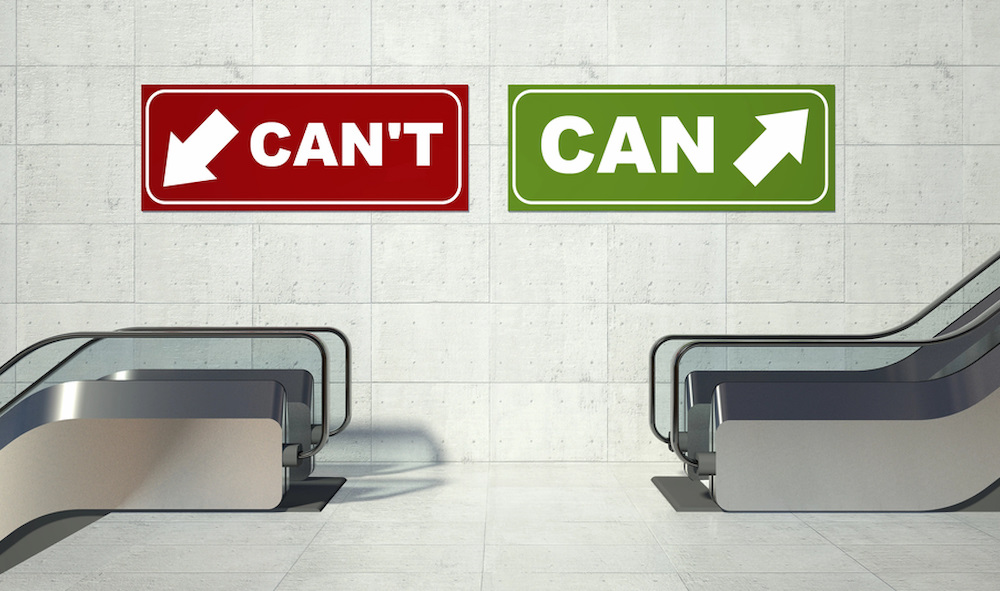

Reframing differs from thought stopping in that it’s a method used for replacing dysfunctional thoughts with more useful ones. Basically, when employing reframing as a psychological technique, rather than attempting to stop any dysfunctional thoughts, the aim instead is to repurpose them
In order for these techniques to work effectively though, you must first be aware of your thoughts and have the capacity to notice as soon as they start becoming dysfunctional. For this reason, there is a heavy psychological component involved where both of these techniques are concerned. Dysfunctional thoughts often stem from a source of dysfunction, whether that source is a minor or a major one. Thought stopping and reframing are both very similar in that they require you to be able to accept the source of any dysfunction (traumatic experiences, fears or phobias, etc), that are causing these thoughts to occur. Moreover, you need to have already made the conscious decision to overcome them, particularly in the case of reframing, by resolving to use such thoughts to your advantage through the implementation of such techniques
Once such factors are in hand, the process becomes very similar to that used in the thought stopping technique outlined above. It revolves around your capacity to condition yourself to use your negative thoughts as a trigger, then to decide on an appropriate action, image, or self-talk phrase to associate with in order to reframe them

Applying reframing to other facets of your Interview preparation
As a cognitive enhancement technique, remember that reframing is very useful because it doesn’t necessary need to be exclusively tied with self-talk, but rather, any time you feel yourself thinking a dysfunctional thought that could hinder your ability to perform well in an interview, (or in any other situation where you feel nervousness and dysfunction start to kick in for that matter – for instance, where you might start to feel comparison anxiety before the beginning of your interview when waiting with other candidates in the lobby) you can use reframing to redirect your thoughts onto things that are more constructive through the association of a phrase, image, or action
For instance, where you find yourself becoming overly nervous, you could try reframing this by triggering a thought where you have triumphed in a past situation where a task or action was challenging
Example of negative internal/ external dialogue repeated regularly
‘I’m going to fail this interview’
You recognise that your self-talk has started to become dysfunctional
Mental trigger: Internally or externally say to yourself, ‘Remember the situation you were in before.’
Or
‘I’ve got a better chance than most because I’m a great fit for this role and I’ve got pre-rehearsed things to fall back on if I need to.’
Physical trigger: Clasp your hands together for 5 seconds
Image

As far as the two techniques go (reframing and thought-stopping), they are really very similar. Deciding which to use really depends on what works best for you. There is a bit more to reframing because, as you may have surmised, instead of merely trying to stop negative thoughts, we are trying to repurpose them instead so that they become more constructive and useful to us. As such, there tends to be a bit more in terms of being psychologically invested and the cognitive process you must go through to reach your goal when it comes to reframing. As always though, the guidance in the first instance is to use whichever technique you feel works best for you…because in this way you are guaranteed to get the most out of it!
Once you become more accomplished with these methods, you can then build on them in ways that are more elaborate, and, depending on the types of situations you find yourself in, can then attempt to delineate multiple types of triggers so you can make the most effective use of these methods as possible if you want
Self – talk…how to practice and how to use it
When practicing self-talk, saying phrases out loud can help immensely. However, on the actual day of the interview, remember that it’s always best to use internal modes of self-talk
Use Repetition


Don’t hesitate to go over the same self-talk phrases over and over again. This constitutes good practice and is what self-talk is really all about. That’s because it’s one of the most effective ways to reinforce positive thoughts and memorise the self-talk phrases you wish to employ. However, with this point in mind, psychologists also recommend that for the most effective results, self-talk should be kept brief and minimal – so for this reason, as you become more proficient with it, ideally you should aim to reduce your overall amount of self-talk over time
Combine your self-talk with Imagery

Even something as basic as picturing yourself succeeding as you recite your self-talk phrases can make a huge difference when it comes to how effective it is. That’s why you should use the suggestions from this section and do your best to visualise your success when practicing any internal or external forms of self-talk
Commit your self-talk phrases to paper


While there will be other things you’ll need to prepare for as part of your interview preparation, writing down all of the great self-talk phrases you intend to use makes common sense and is considered to be best practice as it will not only help you to remember them, but initially reading them from a sheet of paper is also recommended as a great method to help you internalise them better too.
That’s why you should write down all of the self-talk phrases you intend to rehearse so you have them as handy reminders that you can refer back to at any time
Conditioning
A large part of the techniques we’ve covered here revolve around your ability to successfully condition yourself into a given way of thinking
In psychology, the term ‘conditioning’ refers to the process by which individuals learn associations between stimuli and behaviours. It is a fundamental mechanism of learning and adaptation, involving changes in behaviour as a result of experience
When it comes to such cognitive enhancement methods, some of the concepts discussed here may on first impression seem overly convoluted or even redundant to anyone unfamiliar with them – however, remember that they have been studied extensively in the field of psychology by qualified professionals, and over time, through meticulous and careful study, have been proven to be highly effective when it comes to their impact on performance
We can explore the rationale behind this a bit further. People normally don’t pay much attention to what they think. Or even to why they think what they are thinking. That’s largely what the cognitive enhancement techniques like the ones outlined in this section revolve around though. They can help us become highly attuned to what we are thinking, because in doing so…by having a deliberation in the things we think…it can have a huge knock on effect when it comes to how we feel, and through this process can help bring us to an emotional and mental state that is perfectly conducive for our performance in any number of different situations in our lives, (most notably in this instance – for how we conduct ourselves during an interview situation).
…Just like how physically working out and repeating the same action over and over strengthens the body and builds muscle, making the effort to be self-aware of what we’re thinking and taking deliberate steps to condition ourselves mentally by preparing until only helpful thoughts are prevalent at the times we need them most will make a huge difference to our overall performance. It will also have a visible effect on our confidence levels too, which is immensely beneficial when it comes to keeping negative thoughts at bay, and overall, these things combined have been proven to have a huge knock-on effect when it comes to how we end up performing in interview situations.
Like anything though, you get out of it what you put into it…
Lastly
Remember that the things we’ve discussed in this section can not only be incorporated into your preparation and used to enhance your performance in an interview situation, but can also be used to enhance your performance where any number of different facets of your life are concerned too