THE BEST GUIDE FOR DEALING WITH INTERVIEW NERVES ON THE PLANET – COURTESY OF INTERVIEW PROFESSIONAL
There is a lot that goes into getting a job
From the moment you decide to take that next step forward in your life or career, you can expect to spend countless hours on each and every aspect of this journey. Before we even start to count the time spent contemplating the types of jobs that would be the right fit for us in the first place, we also need to spend many more hours searching for those jobs, then from there, take even more time to narrow down a shortlist of worthwhile ones to apply for. Next, we can expect to spend a vast amount of time filling out applications, (sometimes having to source specific information and details in order to fully complete them), not to mention quite often having to do even more work in the form of things like writing out cover letters and taking online tests and assessments. Then we also need to consider the many more countless hours spent researching and preparing beforehand………….

……………When all is said and done, it takes no small amount of work and commitment to even get to the interview stage itself. So, with all your hopes, aspirations, financial needs, and worries, all dependent on the outcome, it’s no wonder that interviewing has traditionally been considered a very nerve-wracking experience indeed
But it doesn’t necessarily need to be so
There are highly effective, practical techniques you can employ to alleviate these concerns, and in doing so, help you to not only enhance your performance, but have a much better interview experience overall, and we will explore these techniques here in this section below
Let’s start by asking ourselves, what is nervousness?
Nervousness is defined in the dictionary as a natural emotional response to actual or perceived situations of mild or acute duress
Whether it’s real or imagined – this is normally a response brought about by the onset of the perception of a threat. It could be something physical, like the perceived threat of harm or imminent danger – or in this case, it could be something relevant to an interviewing situation like the fear of judgment, failure, embarrassment, or simply just the prospect of an unfamiliar situation
Nervousness is typified by different physical and mental reactions. Once the brain recognizes a threat, it releases adrenaline and cortisol which are the body’s primary stress hormones. Adrenaline boosts energy and increases heart rate, preparing the muscles for action, and cortisol focuses attention on the perceived threat and suppresses some of the body’s non-essential functions. As such, it can lead to several physiological responses in the form of things like increased heart rate…muscle tension…and sweating
When we consider these physiological reactions and the types of things that can cause them to occur, we will quickly come to realise that there are many different methods we can use not only to alleviate these reactions, but in some cases, even use them to our advantage!
In this regard, when it comes to nerves and how we deal with them, many comparisons can be made between interviewing and competitive sports psychology
The following are common methods used in areas like sports psychology to alleviate nerves and improve performance, although there’s no reason why you can’t take some of these techniques and apply them yourself before an interview (or to any other type of challenging everyday situation that you might encounter too)

Goal Setting

This is one of the most common techniques used today where performance enhancement is concerned. That’s why it is a technique not only employed heavily in sports and exercise psychology, but has also become a very popular method through which individuals can empower themselves to make improvements in any number of different facets of their everyday lives. As such, it can also give you a direction and a focus that is incredibly useful when it comes to alleviating interview nerves
While in a professional capacity goal setting is normally used for the purpose of achieving specific career goals, (usually consisting of different types of short, medium, and long term goals), there’s no reason you can’t repurpose this method to enhance your interview performance and beat your interview nerves both at the same time too!
Goal setting is recommended as a highly effective performance enhancement technique due to its ability to direct attention, mobilise effort, and increase persistence when it comes to pursuing the goals you are trying to achieve. As such, it’s a great method for redirecting your energies away from feelings of stress and nervousness, and instead refocusing them onto the areas where you need them most
Use a great template when setting goals for yourself

Example of a template translated into a foreign language.
Wherever goal setting is involved, having an amazing template can make all the difference. Our templates are some of the best around, and they function ideally both as action plan as well as dedicated goal setting templates
The right templates can help you maximise your chances by enabling you to focus your efforts so you can plan out your steps when preparing for your next interviews with more efficiency so you can reach your goals quicker
image placeholder
Find the perfect ones you’ll need to reach your goals right here.
(These can also be found in our excellent section, How to Create your own Action Plan,
too)
How to set effective goals
No matter what the goals you set are, it’s important that they are as effective as possible so that you get the most from them. For that reason, one of the first recommendations when it comes to goal setting is to always follow the SMART acronym

the SMART acronym goes as follows
- Specific – Define exactly what you want to achieve. Avoid vague statements like ‘I want to prepare for an interview’ and instead be as specific as you can by identifying the ‘who’, ‘what’, ‘why’, and ‘where’ of the goal

Example
‘I want to rehearse responses to five competency and behavioural based questions in the library using the STAR response method so I can use them in any of my upcoming interviews’.
- Measurable – Do your best to ensure that your goals include criteria or metrics that enable you to track and measure your progress in quantifiable ways

Example
‘I will complete two practice interviews by the end of the month’.
- Achievable – While you should strive to make your goals challenging and push yourself to get as much from them as possible, at the same time, your goals also need to be achievable too. Not only will you be wasting valuable time and energy if you set goals you can’t achieve, but where you don’t achieve them, it will also increase the likelihood of you giving up on setting further goals to improve yourself in future endeavours too. For this reason, take into account the resources, skills, and time you have available when setting your goals…an example of an unachievable goal could be something like this

Example
‘I will land the dream job I’ve always wanted within the next month’.
(This could be considered an unachievable goal as there is no guarantee that you’ll be able to get the exact job you want within this timeframe. A more achievable goal would go something along the lines of this)
‘I will give myself every opportunity to land the dream job I want by making ten applications over the next month’.
(This is an achievable goal because it’s something that is within your power to be able to do)
- Relevant – It’s important your goals are relevant to the thing you are trying to achieve too. When it comes to interviewing, this means your goals should be interview focused and career centric

Example
‘I will take more time for myself and relax for at least 3 hours each day for the next 2 months ‘. (While it is certainly a worthwhile goal that could be used in conjunction with other types of goals, it is not necessarily relevant to the pursuit of getting a new job and making yourself more interview ready)
Here is a goal that’s more relevant when it comes to interviewing
‘I will revise the questions and answers to some of the most commonly asked interview questions for 1 hour a day over the next 3 weeks.’

(This would be considered a more relevant goal as it directly relates to interviewing and your level of interview preparedness before your next big interview)
- Timely – While there are different types of goals (in the way of short, medium, and long term goals), meaning that each goal you set will have different timeframe depending on the goal type and its overall objective, the purpose of the timely acronym is to emphasise the importance of setting goals that are within a timeframe that is relevant to the overall objective you are trying to achieve

Example
A goal to participate in 2 practice interviews within the next 6 months would not be considered a timely goal, as 6 months would be the sort of time range you would set for a medium term goal, but participating in 2 practice interviews would be something you should be able to accomplish a lot sooner, within the course of 2 weeks/ 1 month, and as such would be regarded as a short term goal
Conversely, a goal you set to make 10 different applications within the course of a month would be considered a short term goal that is also both relevant and achievable…
…For more information on the different types of goals you can set for yourself, see Interview Professional’s Best guide to enhancing interview performance
Imagery
Imagery is another great technique that you can use to enhance interview performance and reduce nerves both at the same time. In sports psychology in particular, and in psychology in general, it is another method utilised extensively to get great results
Imagery can be defined as the process of using the senses to create or recreate an experience in the mind. The best time to practice imagery is right after an event – therefore, when we consider how best to employ this method before an interview, utilizing this technique right after you’ve spent time practicing or researching for an interview would typically be the most effective



- In psychological parlance, imagery can be defined as a cognitive practice whereby the individual imagines themselves being successful in performing a given task or action. When it comes to interviewing, this would be things like conducting yourself calmly and confidently in the interview itself, exuding charisma and building a great rapport with your interviewer, visualizing yourself being offered the job, and having a great experience in the interview overall
Imagery plays a vital role in psychology and is used in a multitude of different ways, being employed heavily both as a therapeutic as well as a performance enhancement method. The premise behind this psychological technique is simple. It involves creating vivid mental pictures and sensory experiences in the mind. (This is done solely through the use of cognitive mental processes, in short, through one’s imagination, which is where the word, imagery, derives its name)

Treatment of phobias, reframing negative thoughts, stress and anxiety management, performance enhancement (sports psychology), pain management, trauma therapy, skill acquisition and learning, motivation and goal-setting, are just some of the areas where imagery is used as far as treatments and coaching is concerned
Visualizing a brilliant performance is a great way to eliminate nerves and self-doubt while boosting your confidence so you can go into your next interview in the most successful state of mind you can imagine
For more information on imagery as an interviewing enhancement technique, see Interview Professional’s Best guide to enhancing interview performance
Self-talk


Self-talk is another highly effective technique you can employ and one that has been proven to be highly effective when it comes to alleviating interview nerves and increasing your chances of success. The great thing about this method is that it’s really easy to use, and some people even employ this technique internally as a means of stress reduction when participating in the actual interview itself too
Self-talk is defined as an internal or external dialogue through which a person can interpret emotions and perceptions, as well as reinforce and regulate their feelings and convictions, in the process, enabling them to provide themselves with instructions and encouragement
(During any practice leading up to the interview it is fine to use external self-talk dialogue, however, on the day you will be around other people in an interview setting, so if you’re intending to use this as a method to alleviate your nerves then positive, internal, motivational or instructional self-talk is recommended)
When we consider self-talk, the most important thing to remember is that it can be either positive or negative in nature. For that reason, when we look at how best to use self-talk as a means to alleviate our stress and nervousness while enhancing our performance, the evidence tends to suggest that positive self-talk enhances performance, whereas negative self-talk detracts from it, (although while other evidence would indicate it is not always as clear cut as this), following on from one of the most cardinal rules of interviewing – the advice would be to keep everything positive when it comes to the type of self-talk you employ
There are two main forms of Self talk
Instructional – Used for directing your focus onto specific tasks or actions (e.g, ‘remember the 3 most important things about yourself that you’ve practiced rehearsing for the interview’)
Motivational – Used to provide encouragement and reinforcement where one’s actions are concerned (e.g. ‘I can do this’). This is a form of self-talk that increases self-confidence and helps regulate effort

In an interview setting, motivational self-talk is typically the more helpful of the two self-talk forms
Most interviewing experts would recommend that you use positive, motivational, and or/ instructional internal self-talk. In this way, you can verbally persuade yourself that you have what it takes to ace the interview, alleviate any lingering nerves, and also remind yourself of key points you want to emphasise in the conversation with the interviewer too

Here are some suggested self-talk phrases for the interview
Confidence Boosters
‘I’ve got this’
‘I’ve come prepared’.
‘I’m everything they’re looking for’.
‘I’ve got everything they need and more’.
‘I belong here’.
For Composure
‘Stay calm, you’ve got this’.
‘There are plenty of other chances if I don’t nail this one’.
‘Take it one question at a time’.
‘It’s natural to be a little nervous, everybody gets this way, even the interviewer’.
‘Everyone else here is in exactly the same boat as me’.
For Focus
‘Stay focused, you’re doing great.’
‘Remember the S.T.A.R response practice answers you’ve memorised.’
‘Structured and concise…Structured and concise’.
‘Adapt and respond…adapt and respond’.
‘Smile and answer…smile and answer’.
Motivation and Drive
‘I’ve worked hard to get here, I’m ready for this’.
‘Chances like this will come and go – but who you are and what you’ve accomplished is here to stay’.
‘No one’s more deserving of this opportunity than me’.
‘I’ve triumphed in much more challenging situations than this before’.
‘Every interview brings me closer to success’.
Positive Reframing
‘It’s okay to feel a little nervous—it means I care’.
‘Don’t worry if you make mistakes – it’s all part of the process’.
‘No matter what happens here – I’ll treat this as a learning opportunity’.
‘I’m here to learn about them as much as they are to learn about me’.
‘Everyone here is feeling the same sort of pressure you are – it’s how you use this pressure that counts’.
These are just a few great examples. Remember that when it comes to self-talk, the thing to remember is that each person is different, and this means that the type of self-talk that you perform as an individual will vary drastically from other people in any given situation. Self-talk is an area that has been studied extensively by psychologists, so to get the most from this technique, it’s recommended that you come up with your own prewritten phrases for it. By rehearsing them, it will give structure to both your internal and external dialogue, and especially in interview situations, (insofar as from the random and varying forms of self-talk people usually engage in goes), this will go a long way to helping you make the forms of self-talk you choose to engage in as impactful and concise as possible
Whether it’s for motivation, focus, composure, or confidence, prewriting and rehearsing key phrases and full sentences is the best and most effective way for you to evoke the most relevant thoughts and emotions you’ll need to enhance your performance on the day – helping you to alleviate any lingering nerves and anxiety, and empowering you to find it within yourself to deliver a much better performance on the day than you had ever even thought was possible
Cue words are another means you’ll have at your disposal to help you focus your thoughts, enhance your focus, regulate your emotions, and direct your attention when utilising self-talk during an interview


Affective cue words are a form of self-talk that can help promote intended or desired behaviours that are shorter and easier to remember than full length self-talk phrases. The premise behind cue words is that instead of rehearsing full-length phrases, a cue word can instead be used to evoke the same thoughts or emotions as that full-length phrase would. By using a single cue word, you can associate it with a full-length phrase or sentence that would normally be used in your self-talk to evoke a particular feeling like confidence, composure, or motivation, etc. In this way, cue words can act as effective mental triggers that enable you to stay aligned with your aims and help you regulate your emotions in an interview setting, meaning that overall, they can reduce the effort needed by you to perform effective self-talk
For example, a phrase that promotes confidence such as ‘I’ve got everything they need and more’, might instead be evoked by a single cue word – because by taking the time to mentally practice it repeatedly, you can condition yourself to associate it with a cue word like ‘greatness’, instead
Other useful cognitive techniques you can use to help keep your self-talk on track
The Thought-stopping technique
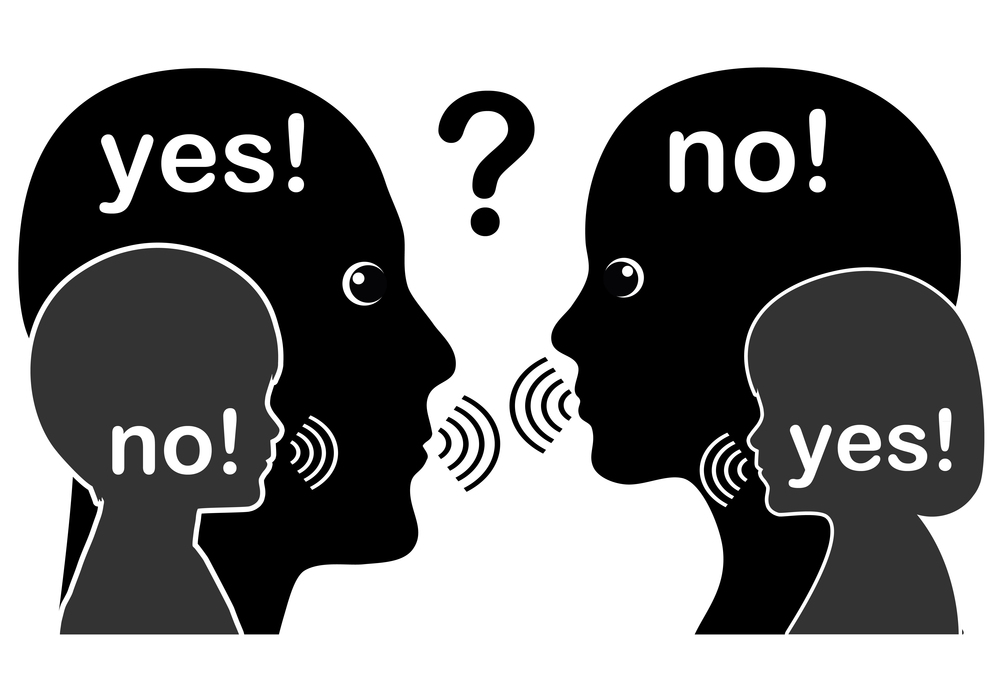
If you find yourself engaging in negative and dysfunctional self-talk, as soon as you become aware of this, you should use what is referred to in psychological terms as a thought stopping technique in order to help you overcome this
Thought stopping as a cognitive technique involves using a trigger in the form of either a word, image, or action. This is something that will help you immediately block out the negative thought, with the aim of recalling a positive one in its place to get your self-talk back on track. You can apply this cognitive method to your thinking by conditioning yourself to bring up this mental trigger whenever you become aware of any negative self-talk starting to creep in. Practice first by using a negative self-talk phrase either internally or externally, and then immediately recalling the trigger you want to use to stop it until this becomes second nature
Example 1
You express a negative self-talk phrase in the form of the following
‘I’m not qualified enough for this position’.
At that point you’ve recognised that your self-talk has started to become dysfunctional
Thought-stopping technique

Image trigger – As soon as you become aware of negative self-talk in your thinking, recalling an image of a time that you performed a task or action that you were not fully qualified for or had never performed before could be an effective trigger to stop the negative self-talk and enable you to return to positive thinking again
Example 2
You express a negative self-talk phrase in the form of the following
‘I’ll never get the hang of this’.
At that point you’ve recognised that your self-talk has started to become dysfunctional
Thought-stopping technique

Word trigger – Internally or externally say, ‘Success!’ to yourself 5 times over

Physical trigger – Clasp your hands together for 5 seconds
As far as interview preparation goes, you should only use this cognitive method if you find yourself engaging in an unproductive amount of negative self-talk
Thought-stopping works best where a mild to moderate amount of intrusive thoughts that are not too overwhelming or deeply ingrained start to creep into your thinking
However, where highly distressing or traumatic thoughts are frequently occurring, more comprehensive therapeutic strategies (like Cognitive Behavioural Therapy or trauma-focused approaches) may be needed
Reframing

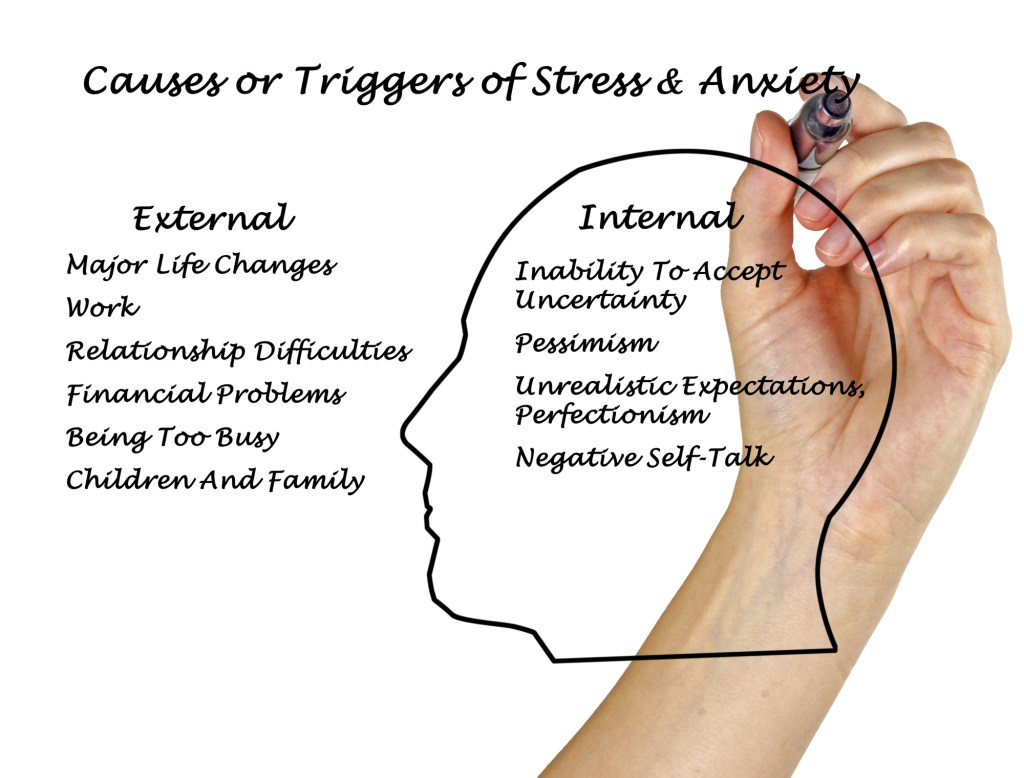
Reframing is also a common cognitive technique used in psychology too.
Reframing differs from thought stopping in that it’s a method used for replacing dysfunctional thoughts with more useful ones. Basically, when employing reframing as a psychological technique, rather than attempting to stop any dysfunctional thoughts, the aim is instead to repurpose them. In order for this to work effectively though, you must first be aware of your thoughts and have the capacity to notice as soon as they start becoming dysfunctional. There is also a heavy psychological component involved with this technique too. Dysfunctional thoughts often stem from a source of dysfunction, whether it’s a minor one or a major one. For this cognitive method to be effective you already need to have come to terms with the source of this dysfunction, (traumatic experiences, phobias, fear of failure, etc), and from there have resolved to overcome these by applying this technique effectively
Once this psychological factor has been addressed, the process becomes very straightforward, and is similar to that used in the thought stopping technique outlined above. It revolves around your capacity to condition yourself to use your negative thoughts as a trigger, then to decide on an appropriate image, action, or self-talk phrase to associate them with
Any time you feel yourself thinking a dysfunctional thought that could hinder your ability to perform well in an interview, you can use this cognitive reframing technique and associate it with a self-talk phrase, image, or action. An example of this would go as follows
Example 1
You find yourself becoming overly nervous and starting to think about failing in the interview
At that point you’ve recognised that your self-talk has started to become dysfunctional
Reframing technique

Image trigger – Condition yourself to visualize a happy moment, then practice associating this with a thought where you have been successful in achieving a task or action that was challenging, (a previous interview where you have been successful and landed the role would be a great example of this)
Example 2
You find yourself worrying about your ability to answer all of the interviewer’s questions fully, and this is causing you to have a tremendous amount of self-doubt
At that point you’ve recognised that your self-talk has started to become dysfunctional
Reframing technique

Word trigger – Condition yourself to internally or externally say, ‘you’ve prepared well!’ to yourself 5 times over. Then practice associating this either with the same thought as mentioned above (where you have been successful in achieving a task or action that was particularly challenging, ideally in an interview situation, although this could also be associated with any other thought that you feel is appropriate)

Physical trigger – Condition yourself to take a deliberate deep breath and straighten your posture, (That’s because this is the type of posture which your brain associates with confidence and composure). Then practice associating this either with the same thought as mentioned above (where you have been successful in achieving a task or action that was particularly challenging, again, ideally in an interview situation, although this could also be associated with any other thought that you feel is appropriate)
Once you become more accomplished with these methods, you can then build on these techniques in ways that are more elaborate, and depending on the type of thoughts you are having, could then attempt to designate multiple types of triggers to associate with the different types of thoughts you have
Best practices for your self-talk
Speak out loud
Say your self-talk phrases out aloud during practice. Once you remember the words and phrases you want to employ, you’ll find your self-talk starts to become easier and overall, you’ll find yourself starting to become more proficient at it

However, while you might utilize external self-talk during practice, remember that it’s always best to use internally based self-talk on the day of the actual interview though
Make use of Repetition

Don’t hesitate to go over the same self-talk phrases over and over again. This constitutes good practice and will help you remember them effortlessly. Repetition will also help reinforce the positive thoughts and feelings you want to project on the day too. However, with this point in mind, psychologists recommend that for the most effective results, self-talk should be kept brief and minimal – utilising it in such a way will help you commit your cognitive focus to the tasks you need concentrate on performing most at the time, while also enabling you to provide yourself with positive reinforcement through self-talk as and when it’s required too. Moreover, as you become more proficient and comfortable with this method, ideally you should aim to reduce the amount of self-talk you perform overall (doing more with less as it were)
Combine this method with Visualization

Picturing yourself succeeding as you recite your self-talk phrases can be extraordinarily helpful when it comes to developing the right cognitive mindset too. That’s why you should use the suggestions from the section above and do your best to visualise your success when performing self-talk
Commit your self-talk phrases to paper

While there will be other things you’ll need to focus on as part of your interview preparation, writing down all of the self-talk phrases you intend to use is also a great practice, as it’s recommended as one of the best ways for helping you remember them
That’s why you should write down all the self-talk phrases you come up with as handy reminders so you can get the most from your self-talk
Conditioning Yourself – What it means


Conditioning – this is defined as a process by which an individual learns associations between stimuli and behaviours. It is a fundamental mechanism of learning and adaptation, involving changes in behaviour as a result of experience
People normally don’t pay much attention to what they think. Or even to why they think what they are thinking. That’s largely what any cognitive enhancement technique like self-talk revolves around though. Just like by physically working out and repeating the same action over and over again strengthens the body and builds muscle, making the effort to be self-aware of what you’re thinking and taking deliberate steps to condition yourself mentally by thinking the same things over and over until only constructive thoughts remain can strengthen the mind, and as such, it can make a huge difference to your performance on the day of your interview. That’s because associating your actions with the right kinds of positive thoughts has been proven to have a huge knock on effect on things like confidence levels that can be immensely beneficial when helping to keep the types of negative thoughts that make you nervous at bay…
…Like anything though, you get out of it what you put in
Lastly
Remember that all of these things can not only be used in the lead up to the interview itself, but can also be used in many other circumstances when it comes to the everyday types of situations you encounter too
You may also want to review the following sections for more information on the techniques outlined above:
The Best guide to Enhancing Interview Performance on the Planet – Courtesy of Interview Professional
Interview Professional’s 3 most Effective Rehearsal techniques for Interviewing
Each of the interview performance enhancement methods outlined above has been studied extensively within the field of psychology, and has been evaluated here so that you can make the greatest use of them. By approaching these techniques as the cognitive tools they are, by applying the methodologies we’ve outlined here to them, and by following the advice outlined here as well, instead of engaging in goal setting, imagery, or self-talk that is only mildly effective, it will enable you to utilise them as the highly effective cognitive tools that they are, and in doing so, enable you to fend off nervousness so you can bring out the best of yourself when it comes to your interview performance…
We have already discussed what nervousness is and defined some of its underlying causes at the beginning of this section. However, it’s also important to understand why it’s so crucial to alleviate nerves so that we are able to go into the interview at our best – feeling as well balanced and composed as possible

Numerous studies have shown that excess nervousness or anxiety can negatively affect your performance by degrading your communication, speech patterns, and the overall body language in the form of the gestures and mannerisms that you employ in your everyday interactions with other people, and this can conversely have a huge impact on stopping you from making the type of impression that you want on the day. That’s why alleviating nerves is so important, as it has been proven to help you maintain the type of composure you’ll need to help you answer all of your interviewers questions to the best of your abilities, as well as helping you make the kind of impression you want by enhancing your judgment and decision-making, improving your verbal communication, and enabling you to project the type of confidence and composure you’ll need to walk into an interview and ace it