S.T.A.R Interview Database (Members Only)
In this section you will
Learn the secrets about ratings systems
Get an insiders look at how competency-based questions are comprised and scored
Get an insiders look at how behavioural-based questions are comprised and scored
Competency and behavioural based rating systems
Sometimes, depending on the scope they have to assess you on, an interviewer may choose not to write anything down and may instead elect to evaluate a competency or behavioural answer you give solely on mental notes alone. This is quite rare though, (and in those cases they will write their assessment of you down on post-interview notes after the interview has concluded)
Most of the time though, they will use a standardized set of scoring criteria, and this goes as follows:
Interviewers will assess you on how well constructed your answers are, and will be listening for specific areas that they can quantify on their assessment sheet. In particular, they will be looking for positive or constructive indicators, specifically, resolutions that end with either a positive or constructive outcome
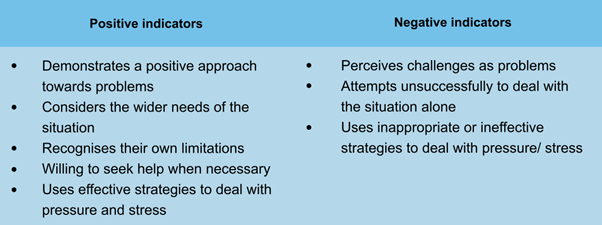
The positive and negative indicators listed here are all pre-standardized. However, these will sometimes be changed to suit the specific competency or behaviour the company is assessing you on. This means at least some of the positive and negative indicators listed here will be determined by the needs of the organisation and on the type of role that you are applying for
Sometimes, negative indicators are divided into two sections, known as minor and decisive indicators
Minor negative indicators are those which have been noted but may be overlooked by an interviewer, but decisive negative indicators are more serious, and will have a largely detrimental impact on how your answer is scored:
For example, exhibiting poor decision making and judgment may be viewed as a minor negative in some circumstances. Whereas exhibiting indicators of poor teamwork will almost always be marked down as a decisive negative indicator
Performance Statements
In addition to positive and negative indicators, Performance Statements are another key component of any competency or behavioural based evaluation. Performance statements are used to give the interviewer a set criteria of guidelines to score your answers against. Each performance statement is standardized to meet the particular question being asked, and will be used by the interviewer to determine whether or not your answer meets the criteria necessary to satisfy that behaviour or competency
Each set of performance statements is industry standardized. That means there is a specific set of performance statements for each behavioural or competency-based question you will encounter in an interview. Furthermore, where a competency or behavioural based question is asked, these industry standardized performance statements are almost always used to evaluate your answers. However, if an employer is composing their own interview framework, you may encounter variants on the industry standardized performance statements if that employer has decided to compose their own ones instead. The other aspect surrounding performance statements is that they can also vary in intensity depending on the level on which that question is being evaluated on – for more on levels, read how Competency levels work further below
For example, below you will find the industry standardized performance statements for the behavioural competency of Accountability & Dependability. If you were asked a question evaluating you on this, here you can see the industry standardized performance statements that would be used to evaluate your answer.
(Note. Some or all of these statements might be used depending on the level at which you were being evaluated on)
-Displays evidence of taking personal responsibility for the duties they perform
-Takes ownership of problems and challenges encountered in the workplace, accepts responsibility for mistakes and takes constructive action to learn and improve from them
-Displays the ability to meet productivity standards, deadlines, and work schedules
-Exhibits evidence of being able to produce a high-quality of work on a consistent basis with little oversight
-Exhibits evidence of always being punctual and on time
For a comprehensive list of competencies and their accompanying performance statements, visit our core competencies section

Evaluation criterion for competency and behavioural based interview questions
Following on from positive and negative indicators and performance statements, there are 3 fundamental scoring factors that will be used to determine not only the effectiveness of these areas, but will be used to assess the overall strength of your answers themselves
These 3 factors are standardized throughout most interviews used in the recruitment industry today
The 3 fundamental scoring factors goes as follows
•Do you have demonstrable experience of the required competency, behaviour, or skill?
•Are your examples relevant?
•How well have you articulated your role and actions, and your contribution to the outcome described in your examples?
These scoring factors are used in conjunction with a standardized scoring table that will help the interviewer determine your overall score on any competency or behavioural based answer you give
Standardized scoring table
This is the standardized scoring table used throughout all sectors of the recruitment industry where scoring competency and behavioural questions are used today
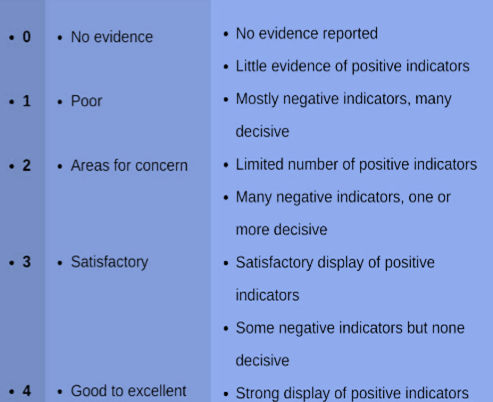
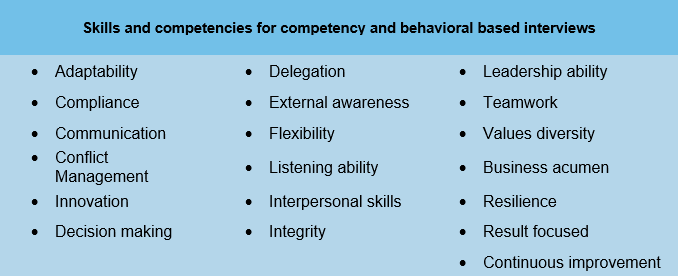
The competencies and behavioural sets looked for will vary from interview to interview, and can change based on the job role, employer, and interview type. Outside factors such as industry regulations and company/ shareholder directives may also be a factor, but the most common areas looked at will include the following
Scorecards and rating systems
Where competency or behavioural based questions are asked in an interview, the above standardized scoring table will normally be integrated into a scorecard (*****add hyperlink****) to be used as part of a larger ratings system the interviewer will use to evaluate your overall interview on as a whole on
Scorecards are typically used to varying extents by interviewers in the candidate selection process. These can range from a numbers-based point system, normally from 1- 5 or 1 -10, to a ranking based system such as good, average, fair, poor, to a pass/ fail based system, or any other ratings scale an employer might conceive of. Where there are multiple interviewers, they will all compare scorecards and share their thoughts on each candidate at the end of the interview. In some interviews, scorecards will only be used as a guideline with which to help the interviewer make an informed decision. Other times, they will be used as the overriding basis from which any decisions are derived. It simply depends on the employer and on the latitude your particular interviewer has been given in that situation
For more information on scorecards – see our Core Interview Strategies section: how interviews are evaluated

Competency Groupings
For the purposes of evaluating candidates in the most relevant manner possible, competencies may be grouped together in different ways
Where competency or behavioural based questions are involved in an interview, candidates will normally be asked 2 or 3 different ones. Grouping them together makes sense from an employer’s perspective because it helps them ensure they are evaluating you in all of the most relevant areas
What this means for you
Many times, how competencies are grouped together is often determined by the HR consultancy firm responsible for comprising the interview on behalf of an employer. The purpose of doing this is to try and ensure that only the most relevant areas are evaluated based on their client’s needs. While it doesn’t necessarily mean much for yourself as an interview candidate, this is an aspect that is still very much relevant because it will influence what questions you are asked in the interview itself – for instance, when a company is composing an interviewing framework, competencies will often times be grouped together in the following ways:
Delivery related competencies – are those competencies that focus on your effectiveness in achieving results based on that organization’s needs, objectives, and measurables. These may include competencies such as the following:
Analytical Thinking
People Management
Performance Management
Project Management
Risk-Management
Staff Management
Interpersonal competencies – are those competencies that focus on relationship building as a means to achieving a more successful and productive working environment, and may include competencies such as the following:
Communicative Abilities
Conflict Management
Delegation
Leadership Ability
Negotiating Ability
Persuasive Abilities
Teamwork
Strategic competencies involve those competencies that involve longer term planning and vision for the future growth and success of that organization, they may include competencies such as:
Business Alignment
Business Strategy and Planning
Policymaking
Future Planning
Strategic Vision
This is just one example of the ways in which competencies can be grouped together. Again, it simply depends on a company’s hiring needs, and on what areas they have chosen to prioritize when it comes to looking for their ideal candidate
There are many other types of groupings that can be applied to a competency framework. For example, a company or HR consultancy firm might choose to group competencies together in a few other different ways such as:
General competencies
Managerial competencies
Skill specific competencies
Technical Competencies
Transferable based Competencies
Or another way is to group competencies like this
Self-awareness based competencies
Organizational strategy-based competencies
Operational and performance-based competencies
Again, it all comes down to the skills an employer is looking for within the particular role for which they are hiring. Such competency groupings can influence the types of competency or behavioural questions you are asked in the interview itself, the specific nature of which being determined by the organization or HR consultancy firm in question

Competency Levels
Many times, in an interview there will be different levels associated with the evaluation of each competency or behavioural question you encounter. This means that the Performance Statements the interviewer uses as a criteria to evaluate your answers with can change depending on the level at which your question is being evaluated on. The higher level, the more complex and challenging the performance statements the interviewer will look for to satisfy the criteria to that particular competency will be. These levels normally range from 1 to 5, with 1 being the easiest, and 5 being the most difficult level to satisfy
How levels apply
Levels for a particular competency could be used in the following situation.
As an example, if an employer was hiring for:
10 customer service advisors,
1 managerial role,
and 3 other support roles that had similarly associated duties and a higher degree of responsibility than the customer service advisor roles, but with less overall responsibility to that of the manager, here’s what they might do
In an instance where they’ve decided the same core skill or behaviour is required across each of those positions, in this case, we’ll use Teamwork as an example, as this is one of the most common descriptions listed on job outlines, and is often sought out throughout all levels of an organization regardless of the role in question. Therefore they would evaluate this by ascribing a level to it depending on the role you were applying for. This would be determined like so:
Competency – Teamwork
CSA (Customer Service Advisor) – level 1
Training and support assistant – level 2
Training and support role – level 3
Expert Support Role – level 4
Manager – level 5
At each level, the requirements sought to satisfy the competency would increase in difficulty, commensurate with the nature and responsibility of the role for which you were applying
Teamwork – level 1
-Listens and responds appropriately to other team member’s ideas
-Offers support for the ideas and proposals of others
-Provides assistance to teammates when they need it
Teamwork – level 2
-Listens and responds appropriately to other team member’s ideas
-Offers support for the ideas and proposals of others
-Expresses disagreement constructively (e.g., by suggesting alternatives that may be acceptable to the group)
-Provides assistance to teammates when they need it
Teamwork – level 3
-Listens and responds appropriately to other team member’s ideas
-Offers support for the ideas and proposals of others
-Expresses disagreement constructively (e.g., by suggesting alternatives that may be acceptable to the group)
-Provides assistance to teammates when they need it
-Gives honest and constructive feedback and shows willingness to receive feedback from peers
Teamwork – level 4
-Listens and responds appropriately to other team member’s ideas
-Offers support for the ideas and proposals of others
-Expresses disagreement constructively (e.g., by suggesting alternatives that may be acceptable to the group)
-Provides assistance to teammates when they need it
-Gives honest and constructive feedback and shows willingness to receive feedback from peers
-Encourages team unity through sharing information or expertise, works together to solve problems. Prioritises team success above all else
Teamwork – level 5
-Listens and responds appropriately to other team member’s ideas
-Offers support for the ideas and proposals of others
-Expresses disagreement constructively (e.g., by suggesting alternatives that may be acceptable to the group)
-Provides assistance to teammates when they need it
-Gives honest and constructive feedback and shows willingness to receive feedback from peers
-Encourages team unity through sharing information or expertise, works together to solve problems. Prioritises team success above all else
-Ensures joint ownership of goal setting, commitments, and accomplishments. Involves everyone on the team
Remember that how competency and behavioural based questions are composed and assessed can vary based on the company and the role, (or on the HR consultancy firm responsible for assisting that company with its hiring needs), which means there is the possibility you may encounter different methods or variations through which these questions are assessed and scored. With that being said though, the method outlined above is the one predominantly used throughout the overwhelming majority of all interviews where competency or behavioural questions are involved, and is the most standardized method for assessing and scoring these questions thoroughout the entire recruitment industry today
If you’re preparing for an interview, the next step is to review the best examples from experts inside the recruitment industry today which you can use in your upcoming interview, or adapt yourself to compose your own examples from, and you can do this now by visiting Interview Professional’s S.T.A.R interview database
Enter the S.T.A.R interview database