
Interview Preparation for Online Interviewing
Online Interviewing (Distance Interviewing)
Online interviewing is a form of distance interviewing that has become more and more popular in recent years. It allows businesses to save time and money, while at the same time enabling them to get a good overall feel for the candidates they interview. Today it’s one of the fastest growing forms of interviewing in the recruitment industry and its popularity shows no signs of slowing down
Depending on the job you’re applying for, an internet interview may either be used as a screening interview for part of a larger recruitment process, or as a one-time only final interview
Online interviews are usually conducted in the format of a structured setting. While you will still have visual contact with your interviewer, as this is an interview type that is not conducted face-to-face in the strictest sense, you may find it different as you’re not in the same physical proximity as your interviewer. Even so, smile and try to project a pleasant and confident demeanour at all times. Keep your hands clasped in front you. While arm gesticulations are acceptable, in the online interview they should be kept to an absolute minimal
There are 2 types of online interviews
Live video interviews
Pre-recorded interviews
Live interviews
Live interviews are the standard type of format for online interviewing. This is where you agree a pre-arranged time to do the interview with the company. You will log in via a link or portal and meet the interviewer in an online room at the predesignated time, then conduct the interview by conversing with them about the job and answering questions about yourself as you would in any other type of interview
Pre-recorded interviews
In a pre-recorded interview, the questions will be presented via an automated program.
While this may seem difficult and awkward at first, it really is a lot more straightforward than it seems. One of the biggest advantages of the pre-recorded format is the opportunity to complete your interview whenever it’s convenient for you, without the added pressure or anxiety of waiting for your interview to commence or of having to interact with the interviewer themselves. With some pre-recorded interviews, you can even start the interview off then stop part way through and come back later to complete the rest of it at a time of your choosing
Another upshot of the pre-recorded interview is that many times you will have the opportunity to go through some practice questions before you begin the actual interview itself. This is great because it not only gives you the opportunity to get used to the pre-recorded format, but it also provides the opportunity to warm up with some practice questions before your actual interview even begins
As a candidate, you will be allotted a set amount of time to read each question, and then be allotted more time to record your answers to them. Once you’ve finished your answer, you can end the question yourself and move onto the next one. The time you are allocated to read and respond to each question is normally presented in the form of a countdown, this way you can see the amount of time you have left. Because you only have a preallotted amount of time to answer each question, it means that one of the biggest challenges is being able to structure your answers correctly, and when participating in the pre-recorded interview you will need to focus carefully on this aspect for each and every answer you give
Overall, there are a multitude of different factors to consider when preparing for your next online interview. Whether pre-recorded or live, any online format will come with its own unique advantages and challenges. This notwithstanding, the fact still remains that the most essential element of any online interview is your preparation beforehand. As you will be participating in this interview from the comfort of your own home or in surroundings of your own choosing, it means you should be paying considerable attention to the layout and visualization of the surroundings in your background before the interview begins. On top of this, there are several other factors that need to be considered before your online interview ever begins that we will explore below:

Start by considering your background settings
Remember that when participating in an online interview, not only will the interviewer be viewing you, but they will also be viewing the background behind you too:
- A clear background, with neutral white or beige colours in the backdrop is the ideal choice, and you should use this as a first option
- A custom backdrop is also usually acceptable. Custom backdrops are pre-loadable picture backgrounds that you can use as your background screen on many online meeting platforms, like Microsoft teams. If you decide to use this option, your backdrop should be something appropriate for an interview setting, like an interview room backdrop. Some backdrops will not look as good as others, and while a certain backdrop may look good to you, if the interviewer thinks otherwise it could count against you. That’s why this should be used as a second option, and due to the wide range of choices in aesthetic, you should be pragmatic and discerning when making your choices here
- A blurred background is another option. This will blur the background behind you so that the focus is entirely on yourself in the foreground. If you aren’t able to make a sufficient natural background for yourself then a blurred background is potentially another option. However, in any instance, a natural or custom background should always be your first and second choices. A blurred background normally looks less presentable and should be avoided if possible
Lighting
Natural indirect light coming in through a window is normally advised as the best choice for online interviewing.
(We’d recommend you check the weather report if you use this option as sometimes it can become overcast quite quickly, changing any natural background lighting conditions)
That’s why another common lighting choice often used is what is referred to as soft lighting. Soft lighting is any discrete lighting source, normally from a lamp, that casts a soft and pleasant illumination over your surroundings.
(It is usually advised you have the light in front or to the side of you in a position that is unobstructive. You can also use multiple soft lights to create the same desired effect or use the soft lighting option in conjunction with a natural lighting source)
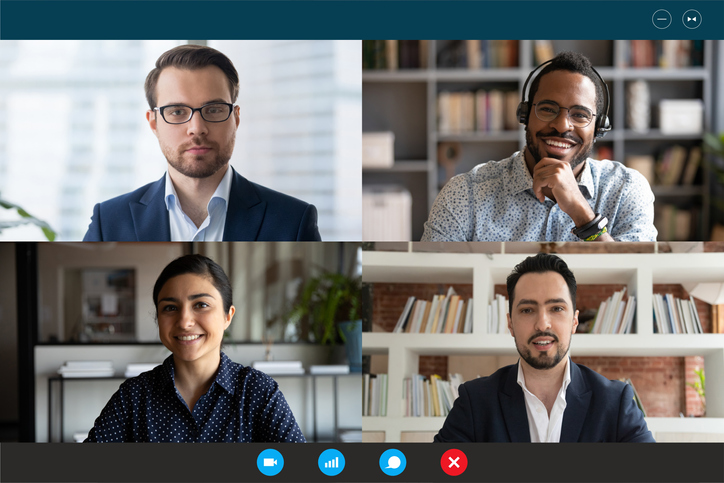
External webcam placement
Most internal webcams are perfectly adequate. However, if you want to stand out with really good quality and think it might make a difference to the set-up you have, you could always opt for a reasonably priced external webcam.
When placing an external webcam, you should try and place it slightly above your eye level, an arm’s length away
Visualization
Proper Visualization requires you to look at the camera and not at the screen. This way, it will give your interviewer the impression that you are making proper eye contact with them, just like you would in a regular face-to-face interview, instead of looking straight ahead, which is how it will appear to your interviewer if you are looking directly at your screen. By achieving a proper virtual eye contact with your interviewer, it will ensure a greater effectiveness in the presentation of your answers and will help you achieve a greater overall rapport with your interviewer
Appearance
You should take the same steps in an online interview that would in a normal interview when it comes to your appearance. In a virtual interview, only the upper half of your body will be visible. In spite of this, you still should dress (fully) in a manner appropriate for the type of interview you are attending
Interruptions
To avoid interruptions and unwelcome noise close all doors and windows.
If something happens and you are interrupted during the interview, stay calm and don’t let it fluster you. Interviewers are professionals who arrange these interviews all the time and are aware that problems can sometimes occur. If there is a noise or an interruption, calmly apologise and wait for it to subside. (Mute your microphone if necessary), and then continue on with the interview as normal
Contact Information
Trying to obtain a contact number so you have a way to call the interviewer if you experience any technical issues during the interview can be a really helpful thing to do. This step is not strictly necessary, and if this happens you shouldn’t panic – as professionals who arrange these types of interviews for a living, your interviewer will be aware that problems like this can sometimes occur, and as such, they will normally be the ones who will call you back if you experience any connectivity issues. They should also be quite forthcoming in arranging an alternative time to complete the interview with you if these problems persist. Nevertheless, trying to obtain a contact number should you experience such issues is still a very useful thing to do and the interviewer will give you credit for taking the initiative

Confirming a time and date
When confirming a time and date, your first priority is to make sure you do this for a time when you can be sure you won’t be interrupted. Because on that day, you will need to make sure you are in a quiet place with no distractions. Turn off the television, turn off any alarms, and ensure you’ve designated a place for yourself to do the interview where there is no noise or distractions (you don’t want the bin man outside when you are trying to talk to the interviewer)
No distractions
Turn off your phone, alarms, TV’s, and any other things that could possibly cause a distraction during your interview
Seating
Use a solid chair as you want the seating to be firm so that you don’t inadvertently move around when you’re sitting at your screen
Headset
Using a headset is still permissible in the online interview and can be really helpful for reducing background noise and for keeping you focused on what the interviewer is saying. Remember if you do decide to use one, make sure to test it out beforehand using the same web application the interview will be conducted on
Technical preparations
If using a laptop make sure it is plugged in, that way you aren’t relying on the battery
Close down all other applications on your computer before the interview. You can do this by right clicking the bottom of your windows screen and selecting the task manager
Use an ethernet connection instead of Wi-Fi if possible. The connection is usually faster and less likely to disconnect than Wi-Fi. If you do use Wi-Fi, try and ensure you are situated as close to your router as possible
Turn off any notifications on your laptop or computer
Test your internet speed
Be sure to test your internet speed before the interview. You can do this by typing internet speed test into the google taskbar, or by going onto sites like http://www.SpeedTest.net. You will need at least 10 mbps download, and 5mbps upload speed, to use most online interview platforms effectively. If it’s not at these speeds call your internet provider for assistance
Test the Link
This is one of the most crucial steps. In most online interviews you will normally receive a link enabling you to access an online meeting room so you can conduct the interview on the day. In this meeting area there is usually a place to check your settings and test to make sure everything is functioning properly. It is imperative you test your settings there to ensure everything works properly before the day of the interview.
(Remember to also check your junk or spam folders for any sent links that might have landed there)
Logging In
Make sure you log in 1hr before the interview, this will give you time to do one final test of the meeting area, that way if there are any problems with the settings you can fix them beforehand

Smile
A lot is said of first impressions in an interview, and nothing is truer than with internet interviewing. Even in a normal face to face interview you will have a small window where you will see and physiologically assess the person interviewing you before exchanging formalities and beginning the interview. In an online interview however, the effect is immediate, because once the screen is connected suddenly the person interviewing you is right there in front of you. In their mind they will immediately make an assessment of you too, that’s why it’s vital you are smiling and looking upbeat so that the first impression they get is one that is favourable and pleasing when they see you for the first time
Recording the Interview
While recording the actual interview itself can provide valuable information and insight and is something you may want to do when taking your online interview, remember that most times you will need written consent from the employer before you are legally allowed to do so
Technical problems
Lastly, there’s nothing worse than breaking the mood of the interview, but if you identify a technical problem that you feel is affecting your interview performance, make sure you bring it up straight away. Remember that the interviewer wants to get to know the real you and will appreciate you bringing this to their attention so they get it resolved and continue on having a genuine conversation with you
Below you will find questions and answers to some of the most commonly asked questions in the online interview. Alternatively, why don’t you look at the link at the bottom of the page for the steps we recommend you take to prepare for your next interview

COMMONLY ASKED QUESTIONS FOR ONLINE INTERVIEWING
1. Can you tell me about yourself?
What is this question
This question serves as an icebreaker question, and it’s a clever one because it not only serves as a good starting point for the interview, but it also serves to get you, the interviewee, comfortable as well. So, it gets you talking while at the same time giving the interviewer a good insight into your character, background, education, and employment history. Being that this question is open ended, it provides you with the opportunity to set the tone and structure for your answer. What also makes this question clever is that the way in which you do so will give the interviewer important indicators about your personality and experience – so from the moment you start talking, they will be assessing these things to see how good a fit you are for the company. Covering such a potentially broad spectrum of topics is also good from the perspective of the interviewer, as it gives them the opportunity to note points of interest or highlight things they may want to come back to later
How to answer this
A nice, polished delivery is what is important with this question.
Don’t be afraid to personalize this answer, you want to try and get the interviewer interested in who you are. A good answer depends on a good structure. So start off by giving a brief overview of yourself, where you’re from, and any notable places you’ve lived. Next, mention or 2 or 3 of your main interests, perhaps providing a little insight into why you like them, and what skills or lessons you’ve gained from them. (Give emphasis to any skills or experience that is relevant to the role you’re interviewing for). From here you should be able to move seamlessly onto your education and work background. Start with your least current job first, touching on past job roles, until you reach your present occupational status. Mention only the job roles that are on your C.V and try to include dates if you can. It also makes it much stronger if you can close the answer with a relevant goal or aim you have for the future. As always, you should prioritize your time when answering this question to draw attention to the roles and experiences that best emphasize the skills and qualities that are relevant to the role you are applying for
Example
‘I’m from New York. I went to Smallville elementary and then later Smallville high school. Living in the city was great because everything I needed was close by. I loved going to the gym and visiting the mall each week. I think living in a large city helped me grow as an individual, because I was able to experience a larger and more diverse variety of things, and this enabled me to gain a healthy perspective on life. I was always very academic in school, and initially I wanted to do quantum mechanics, but found the social sciences to be a better fit for me. I decided to study abroad to further expand my horizons and went to Dauphine University in Paris where I gained a bachelor’s degree in sociological studies. I believe having this education, along with my life experiences in general, has given me a strong foundation to build a fruitful career on in this field, and I’m thrilled to have the chance to interview for this position as a social research consultant here with you today’.
ALTERNATIVE ANSWER
2. How did you hear about this position?
What is this question
Following the standardized structured interview format, this is another icebreaker question. It keeps the conversation between you and the interviewer moving forward, it keeps you talking, and in doing so helps you feel a bit more at ease. It also enables the interviewer to start building a bit of basic rapport with you, which is desirable from the interviewer’s point of view as once you start to open up it will help them more accurately assess you. Another more practical reason for this question is that companies spend a good deal of time and effort to attract quality talent, so they ask this simply because they want to know how effective their recruitment methods are, and are interested to hear about other useful recruitment sources that might be out there. The interviewer will also be listening to see if you mention anything regarding friends or family too. In the vast majority of industries being referred by, or knowing someone, who works for the company is a big plus. Employing a friend or family member of someone who works at a company is seen as a good hiring practice, (such candidates are regarded as having the potential to be more loyal and reliable because they already have an established connection to the company through a friend or family member).
That’s why you will frequently come across referral schemes in various places of work that offer incentives to their employees who refer a friend or family member
How to answer this
Keep your answer brief and simple, a straightforward answer is all that is required here.
If you saw the advertisement on an online job site, say so. If you heard about the opening through a friend or family member, definitely tell the interviewer this. A good way to think of it is that any time you’re given the opportunity to respond to a question, it gives you a chance to put your own positive spin into the answer
Example
‘I applied through your company’s own website in the careers section. I’ve been interested in your company for a while and I regularly check the careers page, so I was really excited to find a job that is such a good fit for me on here’.
ALTERNATIVE ANSWER
3. What do you know about our company?
What is this question
This is a question you’ll normally encounter in an interview, and it’s asked to get a sense of how much you’re actually interested in the company. It’s a straightforward question, and how well you answer it will impress upon the interviewer as to whether or not you have a genuine desire to work for them. It also demonstrates that you are willing to take the time to learn about the company, which also impresses upon the interviewer as to your suitability for the role
How to answer this
Keep everything you say here positive and upbeat.
Researching the company using the ‘about us’ and ‘history’ tabs on a company’s website, or searching online using the companies name, should usually give you more than enough information to use. Compose your answer by compiling 1 – 2 paragraphs about the company regarding its products and services, values and culture, mission objectives, or current news and events with this information. This is one of the questions you should be able to recite easily when asked, so make sure you practice this answer before the interview
https://interview-professional.com/join-2/
This content is accessible only to members of interview professional. Why not consider joining today
ALTERNATIVE ANSWER
4. What will you be able to bring to our company?
What is this question
The interviewer is looking to match your skills and experience to the role. This is a good way for them to evaluate if you have what’s necessary to perform it – that’s why it’s such an important question. Similar iterations of this include; Why should I hire you? What can you contribute to this company? And, why do you think you are a good fit for this role? Essentially, they are all asking the same thing, which is to assess whether or not you can improve on the skills and experience already available within the workplace, while also assessing whether or not you have the necessary abilities to perform well in the role
How to answer this
For this answer to be effective it must be delivered with confidence.
The challenge, like with so many important open-ended questions; is that it can be difficult to construct a response that takes your answer along a structured path.
The place you need to start your answer here is with the job description. As part of your interview preparation, not only should you have familiarized yourself with the requirements of the role, but you should also be familiar with your own skills and qualities and how they tie in with the role too. That is where you should base your answer. Keep it brief and concise. Do this by matching your best skills and qualities to 2 or 3 of the main requirements of the role. Next, bring up an example of something you’ve accomplished in a current or prior role that reaffirms your ability to perform the duties required, (if you can’t think of an example to give, simply move onto the closing part of your answer).
The closing part involves you finishing strongly by recapping key duties you’ve performed in current or prior roles, and restating the confidence you have in your own abilities, while at the same time also expressing the strong desire you have to get the job and start contributing to the success of your future employer…To this end, reviewing STEPS 2 and 5 of our recommended preparation steps – reviewing the job description, write out a list of your most relevant skills – and what you can do that other candidates can’t, write down what makes you stand out from other candidates – will be useful actions to take
Example
‘I’ll bring a first-rate ability to maintain and build strategic relationships with client’s and vendors alike, along with an unbridled enthusiasm and passion for what I do, on top of a naturally sharp and intuitive mind. I am organized, well-prepared, and highly methodical, and this is reflected both in the approach I take to my work and in the quality of my work itself. I’m confident that when you consider my background and performance record, you’ll see I am an excellent fit for this role. The role requires a person with experience of commercial management and contract negotiation, as well as experience of risk mitigation in the financial sector, and my background in all of these areas is solid’.
ALTERNATIVE ANSWER
5. On your C.V you’ve indicated that you have experience using CRM software. Can you outline this experience in more detail?
What is this question
Not only does the interviewer want to know if you can do what your C.V is claiming you can do, but they also want to understand more about a specific duty you’ve performed to see if fits with the requirements their looking for
How to answer this
Challenging open-ended questions like this can prove harder to structure, that’s why basing this around the duties as there outlined on your C.V is the simplest and best way to go with this answer. Try and relate the duties on your C.V to the ones listed on the job description as much as possible. Reinforcing your answer with short examples is also a highly effective tactic that will guarantee you put across an answer that is sure to impress your interviewer
Example
‘I used CRM123. This was a software that I used to access customer accounts and carry out a variety of different actions on them. It encompassed everything from booking appointments, taking payments, verifying transactions, sending correspondence and customer notifications, raising complaints, inputting and amending customer account details, and also logging sales and marketing preferences. This software was central to the role I performed when resolving customer queries and affected the extent to which I was able to influence the ease of the customer journey. It was intuitive and easy to use, and since I started working with it, I’ve also found it easier to pick up on other software applications such as Excel and PowerPoint too’.
6. Your C.V states that you are comfortable taking payments over the phone with customers, that is important because it is an essential function of this role, can you explain in more detail how you went about performing this duty in your previous/ current role?
What is this question
The interviewer wants to know if you can do what your C.V is claiming you can do. In this instance, they have even explained the significance that this question has to the role itself. They want to understand more about this particular function as you’ve performed it in a current or prior role to see if matches with the requirements they are looking for
How to answer this
Challenging open-ended questions like this can prove harder to structure, that’s why basing this around the duties as there outlined on your C.V is the simplest and best way to go with this answer. Try and relate the duties on your C.V to the ones listed on the job description as much as possible. Reinforcing your answer with short examples is also a highly effective tactic that will guarantee you put across an answer that is sure to impress your interviewer
https://interview-professional.com/join-2/
This content is accessible only to members of interview professional. Why not consider joining today
7. Your C.V outlines work experience in the financial sector, in your opinion, what is the most challenging element of these duties as relates to the experience you’ve outlined on your C.V?
What is this question
The interviewer is seeking to understand more about your work history with a view to getting a sense of how good a fit you are for the role. They are also trying to gain insight into how you perceive your past duties so they can get a better sense of who you are as a professional
How to answer this
The best and easiest way to answer a question like this is with a straightforward answer. Giving an honest answer based on your past experience will enable you to speak freely about the challenges associated with a current or past role. Steps 2 and 3 of our recommended preparation steps are the most important here. You’ll need to have a good familiarity with the requirements of the role as well as with your own C.V, because you’ll need to be able to talk about these experiences concisely as you relate what you found challenging about them to the interviewer
Example
‘The most challenging aspect of the role was resolving customer complaints. These are normally situations where there have been one or sometimes even multiple service failings, the result of which has led to a verifiable customer detriment. In these circumstances, customers are often aggressive and very demanding when it comes to reaching a workable resolution regarding their complaint. On top of this, there are also stringent compliance regulations to follow both in the raising and the management of a compliant. The way I deal with these challenges is to always try and set the customer’s expectations as best as I can from the outset. I also make sure I am well familiarized with compliance regulations and that I follow them at all times. On top of this, for me it is very important that I make my customer aware that I am there to help and will try my best to reach a satisfactory outcome for them regarding any complaint I am managing for them’.
8. On your C.V you’ve indicated that you’re able to take the initiative when performing your job duties, can you give me an example of this?
What is this question
The interviewer is looking for evidence that you can do what your C.V is claiming you can. They want to find out if you can take the initiative on a regular basis when it comes to performing your job duties. As such, they will take a strong answer as evidence that you will be able to perform competently in that given role
How to answer this
Remember the interviewer is looking for a concrete example from you. Again, steps 2 and 3 of our recommended preparation steps are very important here. You’ll need to have a strong familiarity with the requirements of the role as well as of your own C.V, because you’ll need to give the interviewer a detailed example from the duties outlined on it
https://interview-professional.com/join-2/
This content is accessible only to members of interview professional. Why not consider joining today
9. If there was one thing you could change or improve within your job role what would it be?
What is this question
A strong answer to this question tells the interviewer that you are an employee who is involved within their working environment. Moreover, it will also give them an insight into how engaged you were in the duties you performed, which is important in how they evaluate you on the extent to which you take responsibility and initiative within the workplace
How to answer this
Anyone who’s worked a regular job will probably have something they would like to have changed, so coming up with something shouldn’t be too difficult. The most important facets of answering this question once again lay in having a good familiarity with the job description and with your C.V (preparation Steps 2 and 3). How you present your answer here is the other important thing. To this extent, keep what you say constructive and try to avoid taking an overly negative tact. Focus on the positives of what the changes could have effectuated rather than the negatives surrounding the problems themselves
https://interview-professional.com/join-2/
This content is accessible only to members of interview professional. Why not consider joining today
10. Do you have any questions for us?
What is this question
This question should always come at the very end of your interview.
The interviewer is extending you the courtesy of asking if you have any questions for them. They are doing this to give you the opportunity to get answers to any queries you might have, or to clarify anything you’re unsure of
How to answer this
You never want to respond by telling the interviewer you have no questions at all. This question is all about having something to say when you are asked. Having something to ask the interviewer shows them that you have been engaged in the topics you’ve covered during the interview, and it also signals to the interviewer that you are interested in the job itself. Not having anything to ask signals the exact opposite. The interviewer is giving you this opportunity to clarify any points, clear up any concerns, and most importantly to ask about things that interest you about the role and the company. That’s why you should always prepare and rehearse 2 or 3 questions to ask them at the end of your interview.
There are a few effective tactics you can employ when composing your questions. To start with, you can base some of your questions around what you learn about the company during STEP 1 of your interview preparation – Research the company. Also, you can choose questions from Interview Professionals Top List of Questions for the Interviewer. Ideally, any questions that you ask should tie in with yourself and reflect well on your motivations and aspirations for the role. Be sure to stay away from asking about salary or benefits, and make sure the questions you ask are open-ended to give your interviewer the chance to respond with long, well thought-out answers
(If you think of another question before the interview starts, or if you pick up on something that is said during the interview that you want to clear up (outwith salary and benefits related questions), don’t be afraid to deviate from the list of rehearsed questions that you’ve prepared. Remember that the interviewer is giving you this opportunity to clarify any points and clear up any concerns that you may have about the role. So while it is fine to take this opportunity to impress upon the interviewer that you are not only interested in the role, but that you are looking to make a name for yourself within the company, don’t neglect to ask questions regarding genuine concerns or issues that you have as well)
Example
‘There are a few questions I have for you, thanks for asking. Firstly…’
Now that you’ve seen some of the most common questions asked in the online interview and the most effective ways to answer them, next, why not have a look at the steps we recommend you take to prepare for your next interview in the link at the bottom of the page
INTERVIEW PROFESSIONAL’S – RECOMMENDED PREPARATION STEPS FOR YOUR NEXT INTERVIEW