How Interviews Are Evaluated
At the end of the day, an interview is only as good as the questions of which it is compromised
This brings us to the next area of fundamental importance; which is the questions that comprise your actual interview itself. When writing out questions for your interview, there are always guidelines that the person or department responsible for this needs to follow, and while some of these will differ based on the company and the type of position they are hiring for, others will conform to strict uniform standards that concern areas an interviewer is legally not allowed to ask you about. As such, to ensure legal conformity, as well as to ensure the most effective questions are asked to evaluate their candidates with as possible, a policy guideline will usually be written out for the people responsible for compiling the questions found in your interviewing framework to follow. It will look like this:
Forbidden lines of questioning
The following lines of questioning are considered illegal and may expose the organisation to risk and litigation. As such, it is forbidden to compile any question that concerns the following areas
Interviewers are specifically prohibited from asking questions based on the following
Age
Criminal convictions
Disability
Ethnic origin
Family Status
Lifestyle
Memberships and organizational affiliations
Marital status
Nationality
Native language
Occupational requirements
Property ownership
Race
Religion
Sex
While an employer is entitled to enquire about certain things, the way interviewers phrase these questions is important. They cannot directly ask you about your nationality or ethnic origin, but have the right to ask whether or not you are legally allowed to work in the country. They are not allowed to ask whether English is your native tongue, but can they choose whether or not to hire you based on your fluency in (English) or the predominant language of the country in question. They are also allowed to ask about your fluency in other languages if it’s relevant to the role (for instance in a role that requires you to speak a second or multiple languages). They are also allowed to ask questions regarding your health and any disabilities that may impact your ability to perform in the role, because this will enable them to ascertain whether or not they would need to make reasonable adjustments if they were to offer you the role, but there are limitations on what they can ask, and they can also refuse to offer you the role if they feel you would be unable to perform in it even after reasonable adjustments were made. On top of this, they have the right to ask other sorts of questions if they can show these are relevant for insurance purposes, and while the employer is legally entitled to do other sorts of checks like criminal background and credit checks too, there are limits on what an interviewer is allowed to directly ask you during the interview itself
If you encounter a question that is illegal, you have the right to refuse to answer it. However, there are a few things you should consider in such an instance. Firstly, you need to be sure the question is illegal before you refuse to answer it, and even if this is the case, if the interviewer isn’t aware it’s illegal, by refusing to answer it, they might be unwilling to offer you the role in the next instance. While it is illegal for an interviewer to ask certain questions, if you encounter an instance where this does happen, proving it is also another thing that can be difficult to do as well. That’s why another tact you could decide to take if you ever encounter this situation is to employ a more diplomatic approach. You can do this by not directly answering the question, but instead by trying your best to steer the conversation away from it, rather than taking a more upfront approach and blatantly refusing to answer the question
As part of the candidate selection process, if you successfully manage to traverse the interview and beat out all the candidates to be offered the role, you will also need to complete further checks as part of the preconditions of your employment. While these will vary based on the role and the legal requirements of the industry in question, the most common types of pre-employment checks you can expect to encounter include the following:
Age verification checks
Background checks
Citizenship and residency verification checks
Credit Inquiries
Qualification and certification checks
Physical fitness tests
Proof of address
Proof of identity
Reference checks
The interviewers responsible for asking these questions will be given instructions on how they should assess you during the interview, and each one will be given different latitude when it comes to the scope they have to assess you with. This will differ from interview to interview, and will be at the discretion of the employer or recruitment firm responsible for hiring new candidates. Below is shown an official memorandum as we take an exclusive insiders look at this process

List of essential traits and experience
Strong work ethic, Accountability and dependability, Communicative abilities, Integrity, Initiative, Team-oriented, Attention to Detail
List of desired traits and experience
Ambition, Determination, External Awareness, Flexibility, Persuasive Ability
From ABC company. To xxx.
This interviewing protocol has been constructed to outline the criteria and responsibilities expected of you in your role as the interviewer. Remember that by selecting the candidate with the right qualities and experience for the role, that you will not only be equipping them for the best chance of success in their career, but will also be helping to secure the long-term prosperity of our organisation
- Determining if the candidate has the both the essential and desired skills and experience sought after for the role
A main function of these duties will be ensuring the candidate meets the needs and expectations we have specified and has both the skills and relevant experience necessary to perform in this role. You will be expected to be familiar with both the essential and desired skills and experience lists set out in your working instructions, and to use yourexperience and intuition to evaluate these accordingly to make the best hiring decisions possible for our company
- Assessing the candidate’s fit with our culture
Equally important as having the relevant skills and experience specified in this protocol, is the ability and potential that any prospective employee has to fit in with the long-term strategic vision of our company, including the capacity to share in our ethos and the ability to meld with the existing talent base within the organisation. With this important object in mind, as a trusted member of this organisation, it will be left to you to use your experience and the knowledge you hold of this organisation to assess whether or not the candidate possesses to the qualities and character needed to fit into the great culture we’ve established here
- Ensuring you are familiar with all aspects of the candidate’s role and are able to verbalise these functions to the candidate in a straightforward manner
Being able to verbalise all tenants of the candidate’s role is an essential part of your duties, as you will not only need to be familiar with all aspects of this in order to evaluate your candidate properly, but your candidate will often have questions about the role as and as their interviewer it is important you are able to put them at ease by answering those questions in the most straightforward manner possible
This is an example of the typical set of instructions an interviewer will receive before their first round of interviews commences. These instructions will be issued either directly from the employer or from the hiring manager to the person responsible for conducting your interview. Remember that interviewers are accountable for every hire they make, and may need to explain their recommendations or hiring decisions where required
There are 2 basic ways to conduct an interview
Without the use of a scorecard
With the use of a scorecard
Without the use of a scorecard
Where electing to use an evaluation system that doesn’t involve the use of a scorecard, it means the employer or recruitment agency is relying upon and trusting the judgement of the interviewer in question. This typically means your interviewer will be someone who is trusted by the employer, with a proven track record of results within the recruitment field
In interviews where a scorecard isn’t used, it will open up the types of interview formats that might be used. Typically, you’ll find more informal types, like semi-structured and unstructured, are used in situations where scorecards are not in use

An interviewing framework will first need to be comprised. This starts with a list of traits and qualities the employer feels it’s necessary for their ideal candidate to have. As shown above, these will normally be broken down into essential and desired categories. Essential skills and experience are always essential for performing the role, whereas desirable skills and experience can normally be learned on the job. If well written, some, or all of these will be listed in the job description, so pay close attention to it. The interviewer will be instructed to look for evidence of these essential and desired traits and experience, like so
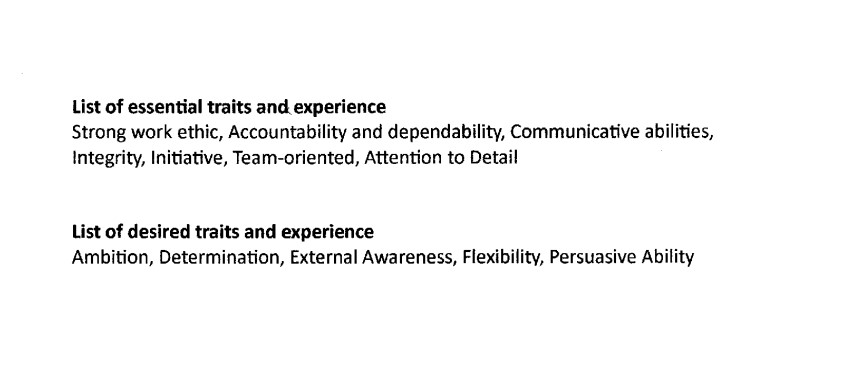
The interviewer will need to review all these criteria and be fully familiar with them before their first round of interviews commences
In order to help the interviewer find both the desired and essential traits required, the employer will next have to decide on an interview format they feel is best suited for evaluating the qualities and experience sought after (to do this they may choose from a variety of different formats such as structured, semi – structured, behavioural etc), then from there, they will compromise a list of questions based around that format
Depending on the format that is decided upon, your interviewer will often times retain a basic question sheet to help stay them on track so they can ask their questions in the correct pre-ordered sequence. This is not the same as a scorecard, and the amount of attention the interviewer will have to divert to a questions sheet when compared to scorecard is minimal
Where electing to use an evaluation system doesn’t involve the use of a scorecard, it means the employer or recruitment agency is empowering the interviewer with a greater degree of latitude when it comes to the hiring decisions and recommendation’s that they make. To this extent, they typically have a greater degree of discretion to conduct the interview as and how they see fit

Takeaways
Interviews where scorecards are not involved are a less formal way of evaluating candidates and typically mean your interviewer will have a greater degree of latitude both in terms of how they conduct the interview, as well as in the hiring decisions and recommendations that they make. While empowering the interviewer to conduct the interview without the use of a scorecard is more of a calculated risk for an employer, it’s a trade-off many are willing to make as it normally enables a more open type of conversation between the interviewer and the candidate. This has to do with the fact that candidates typically feel more relaxed when interviewers aren’t taking notes on every other thing they say, and interviewers in turn can make better evaluations when they don’t have to divide their attention between notetaking and speaking to the candidate. That’s why it’s the most prevalent interview type found within the recruitment industry today, and is regarded as enabling the interviewer to make the best type of assessments of their candidate’s overall
When it comes to the criteria itself, the interviewer will be instructed by the employer or hiring manager beforehand on what areas to prioritise, and what areas to assess only as a secondary consideration. Because they are evaluating you solely on mental recollection alone, they may be more inclined to note your appearance and demeanour than they otherwise would if referring back to a scoresheet. It’s for this very reason that it becomes even more important to answer all of the interviewer’s questions fully when a scorecard is not involved, (even if it means giving an alternative answer to the situation they have outlined), and moreover, to ensure that the conversation between yourself and your interviewer goes as smoothly as possible, which means making your best effort to build a great rapport with them over the course of your interview. Because they will be referring back to mental notes when making their final evaluation, they’ll have a better overall impression of you if can do all of these things effectively
Most interviews will normally contain a mix of things like standard interview questions, situational questions, along with competency and behavioural based questions, and normally the interviewer will be instructed to look for a blended list of abilities to assess you on such as soft skills like Active Listening, Attention to Detail, Communicative Ability, Conflict Management, Creativity, Critical Thinking, Empathy, Enthusiasm, Honesty, Integrity, Resourcefulness and Teamwork, alongside hard and job specific skills such as Budgeting, Coaching Ability, Language Skills, Presentation Skills, Recruitment Ability, Supervisory Experience, an ability to Troubleshoot Problems, proficiency using specific web-based applications and web builders like WordPress, experience performing office tasks such as copying, faxing, printing, to name only but a few
In these types of interviews the interviewer will normally write down notes after the fact, but as they will be going by memory recollection alone, it’s important you do your best to ensure your conversation with them goes as smoothly as possible as they will make their assessment largely based on their recollection of it. Your answers don’t all need to be one-of-a-kind, unique, stand out ones, nor will affect your chances if you’ve had to give alternative answers to one or two of the interviewer’s questions, but it will affect your chances if you have not answered all of their questions fully as this is something they are trained to pick up on
The next takeaway is the most important one. Because irrespective of the interview type, one of the first things an interviewer will always take into account is the overall impression they got of you and how their conversation with you went, which is why rapport building is always emphasised as being so important during the interview itself. In a situation where an interviewer has been instructed not to make use of a scorecard, they will typically have increased latitude to make a determination of you based on their overall impression and professional judgement, and although not all people are naturally charismatic and outgoing, its why interviewing experts advise you try your best to be talkative and outgoing throughout the course of your interview, and their general guidance on how to do this is by matching your tone and demeanour to that of your interviewer. For more guidance on this see our section on Professional Rapport Building here
Lastly, remember that the job description is your friend. Many times, you can get a clear indication as to what the interviewer will be looking for and score some big points simply by referring back to it during the interview itself