
Overexperienced
—————–
Underexperienced
People apply for all manner of different roles in the job markets of today. However, during this process they typically do their best to ensure their skills and experience match the requirements set out by the employer for that specific role. With this being said, there can be instances where people apply for roles knowing their experience and qualifications don’t fully meet the requirements set out by the employer. While such instances are rare, in these circumstances a person might either have too much, or too little, in the way of experience or skills required for that role. Whether it’s because their circumstances have recently changed and they need to resort to applying for work they would otherwise not have applied for, or because a certain type of role that they are under experienced/ over experienced for may now all of a sudden be more suitable for them due to recent changes in their circumstances, or simply because of a lack of options means they can’t find any other work, there can be numerous reasons why people apply for roles that they are either under experienced or over experienced for
In these circumstances, the fundamental thing to keep in mind is that while they may not have exactly the type of skills or experience an employer seeks, these candidates nevertheless understand that by utilising effective interview preparation strategies, they can still have a realistic chance of landing the role they seek. That’s why in this section, we will look at the most important things you can do to present your Overexperience/ Underexperience as effectively as possible when interviewing for a role that you don’t meet all the requirements for

To begin with, as we’ve just discussed, there can be various reasons why you may decide to apply for a role that you are either overqualified or underqualified for. However, whether or not you choose to do so is up entirely up to you. Typically job searching is a time consuming process, and applying for roles that you do not meet all the requirements for can greatly reduce your chances of success. With that being said, it is sometimes well worth the effort to go out on a limb and apply for a role that you truly desire, because on occasion you’ll be presently surprised. However, this is something you’ll ultimately need to decide for yourself, and you’ll need to do so largely based on the knowledge of your own skill levels and experience, as well as on the specific requirements set out for that particular role by the employer. There is a limited amount of guidance that interview professional can offer as concerns when you should or shouldn’t apply for a role in these types of instances and this will be presented to you as you make your way through this section
Overqualified/ Overexperienced

All employers typically gravitate towards people with experience and qualifications, however, there can be instances when having qualifications can be a detraction where applying for a role if you are overqualified
While they DO covet experience, the most important thing for hirers is matching a candidate who is RIGHT for the role

There are several reasons why having too many qualifications can be off putting for an employer. For starters, if they feel you are overqualified, one of the main concerns they will usually have is about your salary expectations. That’s because a lack of being able to find any other type of suitable employment is usually one of the main reasons that someone who is overqualified would be applying for a role with a significantly lower salary. Following on from this, this is also why, in these types of circumstances an employer will often be concerned about your commitment to the role itself; keeping in mind that employee retention is always a key focus for recruiters, especially where considering someone who is overqualified for a role. These are all the types of factors that lead into candidate alignment. That’s because even though you may be overqualified for a role, this does not necessarily always equate into you being able to do the job better, which is why an interviewer will always be highly attentive to your rationale behind applying for the role itself. It’s also why, when it comes to outlining your skills and experience, its essential that you’re able to convince them that the role is perfect for you by showing them just how well these fit with the employer’s expectations in terms of candidate alignment
Candidate Alignment
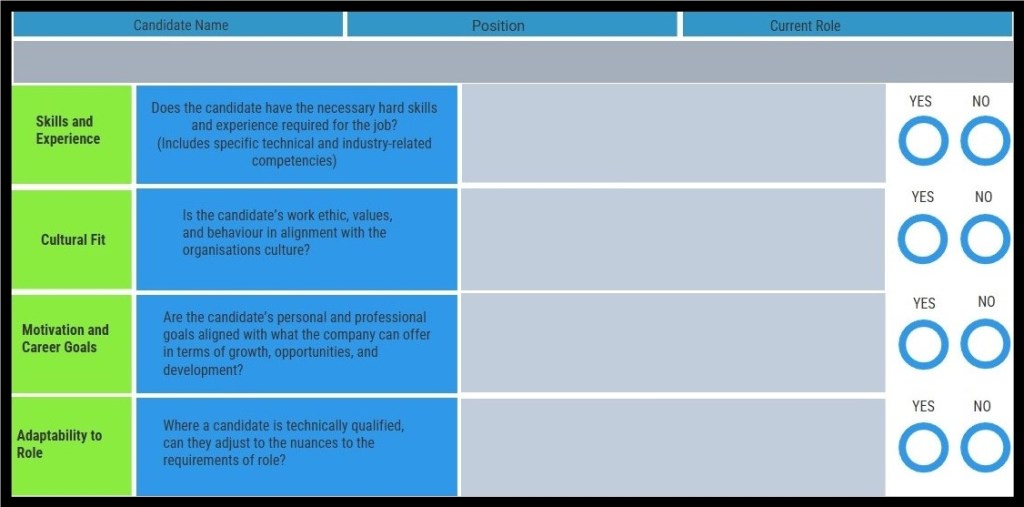
Candidate alignment refers to the degree in which a candidate’s skills, qualifications, experience, career goals, and to a broader extent, their values match the requirements set out for the role. This being in addition to how well their personality matches the company culture and overall objectives of the company/ role itself. In recruitment, candidate alignment comprises a crucial part of interviewing evaluation because it helps to ensure that a candidate not only has the abilities to perform the actual role, but that they also have the necessary qualities to fit in with that company’s culture insofar as being comfortable with the duties proscribed with that role, while in addition being amendable to the long-term goals associated with that company or role too
Here is what an interviewer assessment sheet that prioritises Candidate alignment as a key focus looks like:
Why Candidate Alignment is important to employers
An interviewee who exhibits strong candidate alignment is more likely to perform their duties diligently and feel satisfied in their role. As such, there is the reduced risk of employee turnover and an increased chance of higher productivity. Furthermore, the consensus among experts is that employees who exhibit strong levels of candidate alignment tend to have better workplace values, meaning a better overall approach to their work which tends to resonate well amongst fellow co-worker’s, and this is just one more thing that’s viewed as a huge added benefit by employers
To what extent an employer chooses to focus on candidate alignment will depend on the employer and on the role in question. There are several areas employers will usually evaluate when hiring, with candidate alignment usually being one of the main ones. In a situation where you are over/ under experienced though, this is usually an area more heavily prioritised than usual
Where you are applying for a role where you are regarded as being overqualified – it means you have higher levels of qualifications or experience than is needed to perform the role in question. As such, this can lead to the interviewer having concerns over your reasons for applying and about your ability to perform the role in question – so if you want to land the role, it’s your job to alleviate those concerns!!!
The good news is that there are several things you can do that will help you do this
Tailoring your C.V/ Resume

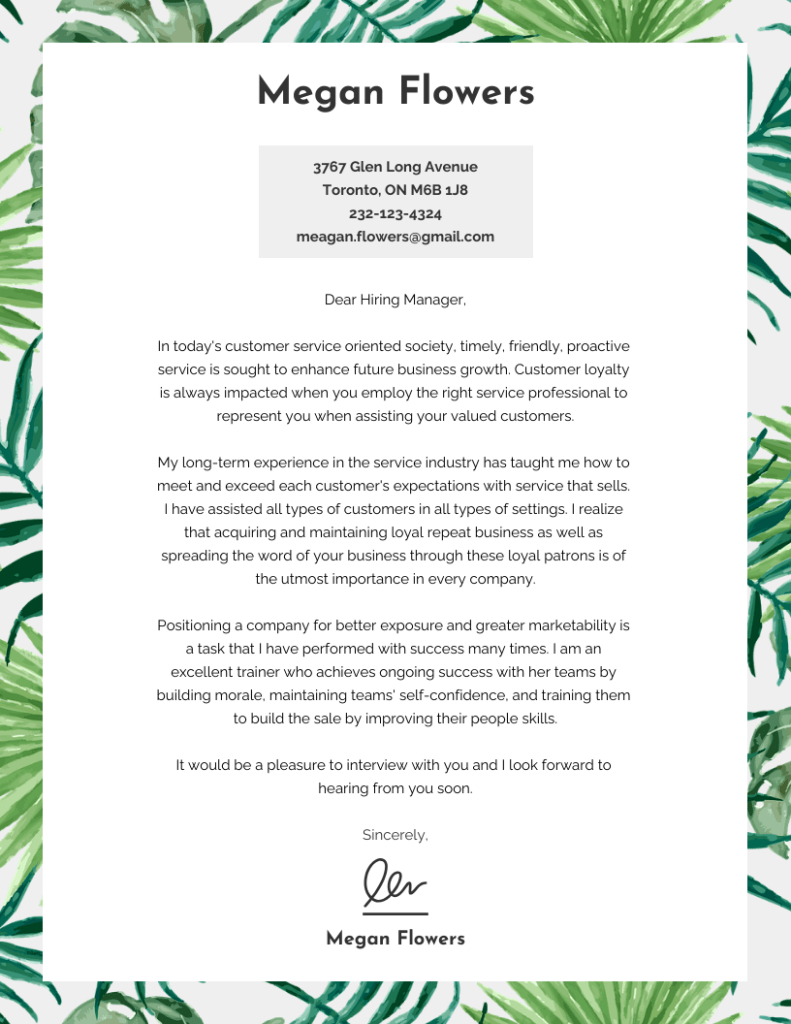

Whether you are underexperienced or over experienced, the C.V/ Resume is the first and most important part of making it past the opening stages of the candidate selection process. In order to do that though, there are a few important rules you should follow
Focus on your Relevant Experience

- Highlight the skills and experiences that are most relevant to the role, regardless of where you’ve gained them
- Consider putting the listings you make in your sections in a functional based format. This would include the listings in your education section, employment history section, and any optional sections you chose include to
- Consider adding a relevant courses subsection
- For more information on how to comprise a brilliant C.V or resume, see interview professional’s C.Vs and Resumes section here
Shorten the Experience section on your C.V or Resume
Following on from focusing on your relevant experience comes the tactic of shortening the Experience section on your C.V or Resume
In a situation where you are over experienced, it’s another great reason to use a functionally based format. Because with a functionally based format you can go back longer than 10 years if the experience is relevant to the role (the functional side of your experience), but you can also shorten the other employment experience section significantly as well (remember that it is acceptable to omit experience entirely if this not relevant to the role itself)
Tailor your Profile Statement
A profile statement is an area on your C.V or resume where you can either put a job-orientated statement, a personally orientated statement, or a resume objective. A personally orientated statement is more common with students and those who lack actual job experience, whereas a career orientated one is usually used by those with more experience who want to place a larger degree of emphasis on their career goals and accomplishments
Do this by focusing on the skills and experience that make you the ideal fit for the role, focusing less on other information from your qualification background that may not be as relevant. You can also do this by creating a personally or career orientated statement that explains your motivations for seeking the type of role that you are. (A change of location/ change of circumstances/ change of career focus in terms of what you are seeking from your duties moving forward, all make great ways to explain this)
This can be a shrewd tactic in a situation where you are applying for a role that you are either A. Overqualified for, or B. Underqualified for. That’s because it’s normally one of the first and most prominent sections on a C.V or resume so it makes sense to give it some extra attention, and you can use this to clarify why you’re seeking a role that you’re either over or underqualified for, (e.g., a better work-life balance, a change in location meaning a different type of work would be suitable, a desire to stay in that industry but with a change on career focus, etc.)
Example (Resume Objective)
‘As a distinguished retail professional, after having re-evaluated my skillset and experience, I am seeking a part-time cashier role to focus on achieving a better work-life balance due to a recent change in personal circumstances that will allow me to still be involved with customers by providing them with excellent service while also still enabling me to be involved with the day-to-day operations of my organisation’.
For more information on Profile Statements, see the C.V’s and Resumes section, under the Profile Statement tab
Consider tailoring the dates on your C.V or Resume
In a case where you want to apply for a role that you are overqualified for, one tactic that can sometimes help to get you onto the next stages of the candidate selection process is to leave the dates off of your educational qualification listings, (as it makes anyone viewing your C.V or resume less able to pinpoint your age and the exact number of years you’ve held a given qualification, potentially making you a more relevant fit for the role)
Remember tactics like this are short term solutions designed simply to get you onto the next round of the candidate selection process (the interview stages). If asked directly, it is important you are upfront and clear about the dates involved on your C.V or Resume. For more information about potential strategies at your disposal that may enhance your chances of success, see our C.Vs and Resumes section
What does it mean to be Underemployed?

By dictionary definition, this means not having enough paid work, or not doing work that makes full use of your skills and abilities
Acknowledge the Overqualification
In a case where you’ve applied for a role for which you are overqualified, it’s common for an interviewer to have questions and even concerns about your motivations for applying, as well as about how good a fit you’d be for the role itself. It’s for this reason that interviewing experts recommend you get ahead of these concerns by acknowledging the fact that you are overexperienced early on during the interview. There’s certainly no need to overemphasise it, but bringing the fact up at some point early on in your conversation with them will help convince the interviewer that you are being genuine and that your motivations for wanting the role are sincere. In turn, this will help you build trust and rapport which will significantly help your chances when the time comes for them to make their final hiring decision
Compose an effective enquiry message
When in a situation where you are looking to transition into a new role that requires a different skillset from the one you currently possess, then networking and making connections ahead of the actual interview can be an invaluable tool that will help show an employer just how serious you are about the role. In this situation, the best way to do this is by networking with people (ideally from within that organisation…)
A great way to do this is by seeking out the details of people who work in that organisation or industry who are knowledgeable about the role you seek. Do this with one specific purpose in mind. You are looking to connect with those people by composing an enquiry message for the purposes of trying to arrange an informational interview/ informal meeting with them. An informational interview is not technically an interview as such, rather, it’s more akin to an informal meeting, where a person looking for employment in a certain field seeks advice on a job or organisation within that field from a person who has an in-depth knowledge of it. It is a great way to give yourself an advantage not only in terms of the practical information you can gain, but more importantly, in terms of the additional talking point you’ll have to take with you into the actual interview itself
For instance, a former employee involved in retail operations is seeking a position as a part-time cashier, which is typically an entry-level and as such they would be seen as overqualified for the role
In this case, they could seek to contact someone who works in such a role and make a request to hold an informational interview with them, although as you will see from the example below…this is something that usually sounds harder than it actually is…
Example of an enquiry Letter/ Email for someone who is overexperienced
(Your name – Mr X Green)
(Your Address)
(City)
(Postal Code)
(Email Address)
(Phone Number)
(Social media links)
00.00.0000
(Hiring Manager’s Name)
(Organization Name)
(Organization Address)
(City)
(Postal Code)
Dear Mr X Blue,
I hope this message finds you well. I found your details on Interview Professional, and I am writing to you to express my interest in the part-time cashier/retail associate position currently available at (The Organization Name). With over (7 years) of experience in (retail operations), I have an established background in the field of retail as well as a strong appreciation of its processes.
Due to a recent change in my circumstances, I am currently seeking a more flexible part-time role that would empower me to change the way I engage with customers while at the same time enabling me to support my colleagues in a more direct way too. I am passionate about retail, however, I’m concerned that my past duties may lead people to perceiving me being as overqualified for the position I’m applying for. I would be immeasurably grateful for any advice you could give me in this regard and am writing this enquiry to see if it would be possible to arrange a meeting with you to get any insights you may be able to share that would better enable me to align my current skillset with the needs of your company.
If you’re free in the next couple of weeks, I’d love to be able to schedule a 30-minute chat via phone or Zoom with you at some point. If not, I am available for a meeting or further discussion at your own convenience. Thank you so much in advance for considering my request and I sincerely hope to hear from you soon.
Sincere regards,
{Mr X Green}
Here we can note several things that an effective enquiry message does
- It introduces the candidate and makes their purpose clear. This is because it clearly states their intention of transitioning into a cashier associate position
- It states how they know the recipient/ how they acquired the recipient’s details, and also indicates that the candidate has experience that makes them overqualified for the position they are applying for. (Either stating this or highlighting the relevant experience you DO possess as it relates to the role is recommended so the recipient has an understanding of your background and why you are contacting them)
- It clearly outlines the reason for the transition. In this case the candidate explains there has been a recent change in their personal circumstances…
- It contains a clear request for a meeting. In this example the candidate politely asks for the opportunity to gain a further insight into the role/ industry by arranging a virtual or phone meeting
- The message is respectful, formal, and expresses enthusiasm about the opportunity for the chance to discuss the role further
If they agree to the meeting, be sure to use the time wisely. Have a list of questions prepared and focus on what it’s like in the day-to-day aspects of their role. What are the most effective actions within that organisation and/ or industry to take when it comes to career progression? What was it like when they were on boarded? What have they learned and how have they grown since starting in the role?
There may be different reasons why someone would agree to a request to participate in an informational interview with you. Perhaps they are looking for career progression themselves and see the prospect of hosting an informational interview as something that would look good on their C.V, or perhaps they were in the same situation as you at some point and understand what you are going through…whatever their reasons though it never hurts to ask, because if you don’t, the opportunity to do something like this will continue to remain at zero!
For more information on informational interviews, see our section on informational interviews here
Here is the rest of what’s important when it comes to applying for a role that you’re overexperienced or overqualified for…
Go into the interview planning to focus your interest on the company!

A sensible tactic to utilise during an interview even in normal circumstances, by focusing the conversation on why you want to work for that particular employer, it is not only a great way to demonstrate your enthusiasm for a given role, but is also a great way to convince them that your planning to stick around for the long term which is always helpful in a situation where you are overqualified for the role
Align your salary expectations to the role

One of the most common questions/ concerns an employer will have is around current/ most recent salary, as well as what your new salary expectations are. Remember that being overqualified for a role typically indicates a reduction in salary. That’s why, in the first instance, it would be wise to align your salary expectations with the role you are applying for. In the second instance, make sure you prepare beforehand so you are able to present a credible rationale as to why you would be willing to accept a reduction in salary (e.g. personal circumstances/ a renewed focus on a certain aspect of your career. etc)
Focus on your Long-term goals

Just like when it comes to the topic of career change, one of the most effective tactics you have when it comes to applying for a role which you are overqualified for is to keep the conversation moving forward, focusing on what you aim to achieve in a new role as regards your goals for the future!
Ensure you are able to present a convincing rationale as to why you want the role

Applying for a role for which you are overqualified usually connotates several different things in the mind of any interviewer. As we’ve already discussed, it can raise questions about your salary expectations, as well as about your motivations for applying for the role in the first place. For this reason, when you apply for a role which you know you are overqualified for, it’s crucial that you are able to present a convincing rationale as to your reason behind doing so. In order to help you do this, it’s advisable to review the following sections
Interview Professional’s 3 most Effective Rehearsal techniques for Interviewing
Approaching the topic of Career Change in an Interview
How Interviews Are Evaluated
There can be various reasons why people might apply for a role for which they are overqualified, such as wanting a more flexible work schedule, wanting a job with less travel involved, wanting to spend more time with family, or, due to recent changes in their personal circumstances, it simply becomes the case that a certain type of roles they are overqualified now becomes a better fit for them. Only you will know the reasons behind why you want to apply; just make sure you prepare beforehand so you can present these reasons as effectively as possible in the interview…
…Lastly, if you make it to the interview stages, as we’ve already discussed, it is important that you are upfront and address your overexperience/ overqualifications early on in the interview. This will help to convince the interviewer that you are having an open and honest conversation with them. Do this by first outlining your experience/ qualifications, taking care to describe how you feel these align with the role, and then acknowledging the facets of your experience that make you overexperienced/ overqualified for the role itself. In this way, you’ll be able to show that you’re being upfront about the things that you say, then from there you can move quickly on to cover the relevant experience you do have, as well as to convey your interest in the role which you can then work into an effective rationale as to your reason for wanting to change roles too


In this situation, remember that the perceived disadvantage you have of being over or underqualified will largely dissipate once you make it to the interview stages. Once here, the playing field becomes more level and your main challenge at this point becomes convincing the interviewer that you are exactly the type of candidate that they need for the role. Do this by building a great rapport with your interviewer, do this by giving strong answers to each of their questions (showing, not telling them) through solid verbal examples, and more importantly, do this by believing in yourself and by preparing beforehand so you are able to present yourself and your relevant experience in the most effective ways possible