What Employers look for in the Interview
Employers hold many of the cards when it comes to the job markets of today. With multitudes of applicants applying for every job, and multitudes of different places to source potential candidates from, employers can be very selective about who they hire indeed
But at the end of the day, no matter how much of an advantage they may hold, hiring an employee is still a two-way street. We all apply for jobs because we need them so we can earn a wage to live on, but no matter how many people apply for a role, employers will eventually need to narrow this candidate list down and select from the person or persons they feel will be most beneficial for their organisation and for the role itself. Much as in the same way that a candidate, once hired, comes to rely on the regular income their employer provides – once hired, an employer, in turn, will come to rely on that candidate to perform in the role to the best of their ability and carry out their duties diligently so that their organisation can thrive. Employers understand this, and in the fast-paced job markets of today, they are all too aware of the time and cost implications of making bad hiring decisions. As the most important part of the candidate selection process, the interview is crucial in helping employers discern which candidates will make the best fit for their organisation. Therefore, when it comes to the interview itself, what exactly is it that employers most commonly look for?
Interview Professional has identified several areas that will have the biggest impact in your next interview. While some of these will overlap with traditional core competencies, other will not, however, what these areas all have in common is that they are things which employers will either actively or passively look for, and as such, are considered to be especially important. On top of this, our interviewing experts have also identified several other areas employers will also typically pick up on over the course of your interview, and we will examine these too. All of these areas are highly impactful and if prioritised correctly, can lead to you gaining a big advantage over other candidates in your next interview

EMPLOYERS LOOK FOR CANDIDATES WHO SHOW THEM RESULTS
No matter what the industry, no matter how generic it may seem, another thing that always impresses in an interview are the times where you are able to provide strong verbal examples of impressive results. One of the most common ways you can do this is in the form of statistics
Even if you have to fit the statistic around the result in question, (as long as you are truthful when doing so) you’ll find the result will often be well worth the effort
For instance, when asked the question
Why should I hire you?


‘You should hire me because I’m highly motivated, I love what I do, and I always go out of my way to put the customer first. To give you an example of how I apply this approach in my daily duties, in my previous role, there was a big change in our department after our company got restructured, and as part of that change, my role was moved from a telephony-based service to an online first contact center-based one. During that transition, our business relied on us then more than ever to meet the needs of our customers, and to give you an example of how I stepped up to this challenge, in my last performance review just before the changeover; I’d managed to serve 415 customers in that quarter. This was 7% percent more than the department average, with a satisfaction rating of over 80%, which put me in the exceeding bracket. In the next quarter after the changeover, we had an increased customer contact demand of over 21% percent, which is massive! Much of this was driven by customers with queries about their accounts being moved across onto our new system. I helped my business meet the increased customer contact demand by successfully serving 521 customers in that quarter alone. This was a 25.5% increase over the previous quarter, and I did this by not only quickly learning the new system processes, but by collaborating with my colleagues and by always putting the customer first in everything I did’.
Other examples could go something like this
How I took ownership and delivered specular results in the workplace
S.T.A.R Behavioural-based Interview example
Situation
I was working for a telecommunications firm where I was responsible for handling customer inquiries and resolving issues related to billing, service outages, and technical support. The situation was that my company had been receiving bad press for the poor handling of customer service enquiries recently, and this was affecting our companies sales growth and customer retention figures
Task
My task was that I’d made it my personal responsibility to take ownership of any problems I encountered such as long wait times, complex queries, unresolved issues, and the overall poor customer service that was causing repeat contacts
Action
The action I took was simple. Customers were often calling multiple times to resolve the same issue. This was leading to increased frustration and dissatisfaction, as well as to time consuming complaints that were related to recurring problems. However, by taking full ownership whenever I encountered such issues, I was able to address these without further escalation
Result
This enabled me to personally deliver impressive results for my organisation. Not only was I able to increase my customer service satisfaction rating 21% percent higher than the department average that quarter, leading to increased customer retention figures, but because I was able to resolve more of my customers issues at first point of contact, my sales were 7% higher than the department average too!
How being proactive helped me make a huge difference in my workplace efficiencies
S.T.A.R Behavioural-based Interview example
Or
S.T.A.R Competency-based Interview example
Situation
I worked on a manufacturing line printing circuit boards for electronic devices. The situation was that the FPY (First Pass Yield) on the line was at 87%, meaning 13% of all manufactured units required rework or scraping after the first production pass. This was leading to increased production costs, delays, and reduced levels of efficiency
Task
I made it my personal task and responsibility to make my First Pass Yield as high as possible to help improve our overall team efficiency
Action
While my own First Pass Yield was higher than the team average, I still wanted to improve my work, so I needed to understand where the errors where occurring. That’s why I took action by seeking out information from the analysis and root cause identification team, and I learned this was happening early on in the manufacturing process. Implementing a fix from there was easy! I began paying more attention to my work during the soldering and component placement at the start of the process, which lead to a huge reduction in my overall errors in real-time
Result
The result was that I was not only able to improve my own FPY to 95%, but by sharing best practices with my team, I was able to encourage some of them to be a lot more proactive when it came to improving their own efficiencies too. This helped us increase our overall FPY by 7% as a team over the course of the following quarter
Manager delivers impressive Results
S.T.A.R Competency-based Interview example
Situation
The situation was that I was brought in as the manager of a store that had been underperforming. Sales had been poor, and the store itself had been suffering from a reduced customer turnout
Task
My task was to get our store back to its expected performance levels
Action
As an accomplished manager, I am used to dealing with challenging situations such as the one I encountered here. That’s why I didn’t make immediate changes, instead, I spent the first few weeks observing the store’s operations, speaking with employees, and reviewing the store records. Based on these observations, I then took action, making several sweeping changes, starting with the implementation of an employee training program to enhance our teams customer service skills, which I personally oversaw myself. I also implemented a recognition scheme so employees would be rewarded for their contributions…but the biggest change I made was to revamp the store layout to create a more customer-friendly shopping experience
Results
The results became apparent as early as the start of the next quarter. Employee turnover had decreased by 12%, customer complaints had dropped by 14%, while at the same time, customer turnout improved significantly by 16%, leading to improved employee-customer interactions and a more positive working environment. Overall, I was able to increase sales by 18% in that quarter alone, and from that point onwards the store began a remarkable turnaround
Conveying examples of times when you’ve delivered great results is by no means limited to prestigious managerial or high-end leadership roles. There are multitudes of other metrics and measurements you can use to provide great examples of this such as Sales (which is a very basic measure of the number of goods or services sold). First Pass Yield (which measures the percentage of products manufactured correctly without needing rework or repairs.). Employee Turnover Rates (which measures the percentage of employees leaving the company within a given period of time). Net Promoter Scores (which is a rating of customer satisfaction). Customer Lifetime Value (CLTV) – which is a measure of the total projected revenue a business can expect from a single customer throughout their relationship with them). Inventory Turnover (this measures how often inventory is sold and replaced over a given period of time). Scrap Rate (measuring how often inventory is sold and replaced over a given period of time). Lead Time (which is a measure of the time from the start of a production process to its completion), and these are just a few of the areas you could choose to base your examples from, but there are also many, many more…Its equally important to remember that these examples need not only apply to frontline roles or prestigious high end positions, but can also be applied to any other type of situation in your life too, even if you are unemployed or have very limited work experience. This can be great if you’ve made personal commitments to attain career related goals or you are committed to getting into/ back into work
Here we examine a few examples from people who have made life commitments to attain results involving career related objectives. The first is from someone who is currently working as a volunteer to improve their career prospects
Getting great results in my capacity as a volunteer
S.T.A.R Behavioural-based Interview example
Or
S.T.A.R Competency-based Interview example
Situation
I was volunteering at the local foodbank, where, due to low manpower availability, the situation was that we were having delays moving foodstuffs around our storage facility to make ready for distribution
Task
I made it not only my task, but my personal responsibility, to do my best for our close-knit team so I could help them strive to overcome these problems
Action
To mitigate these issues, a new color-coded system for categorizing and rotating stock had recently been implemented. The actions I took involved applying myself to the best of my abilities, and using a technique based around and elaborative rehearsal, I was able to quickly learn the new system
Result
Because of the increased efficiency at which I was able to work, the result was that it enabled our small department to achieve quicker distribution times, allowing the food bank to serve upwards of 11% more families each day
OR, you could change the example above to one where you took a more active role in its solution.
Preparing with an example that instead goes something along the lines of this:
How I took the INITIATIVE to deliver RESULTS for our patrons
S.T.A.R Competency-based Interview example
Situation
I was volunteering at the local foodbank, where, due to low manpower availability, the situation was that we were having delays moving foodstuffs around our storage facility to make ready for distribution
Task
I made it not only my task, but my personal responsibility, to do my best for our close-knit team so I could help them strive to overcome these problems
Action
I took action. Applying my extensive experience of the distribution trade, I implemented a new color-coded system for categorizing and rotating our stock
Result
These changes made our distribution system more efficient, enabling our small department to achieve much faster distribution times. This resulted in us being able to serve upwards of 11% more families each day
Other examples could look something like this
I have managed to achieve incredible results in my life by setting daily goals that revolve around exercise, reading, and meditation. This has not only helped me enhance my general well-being, but has also enabled me to maintain a positive mindset that has allowed me to maintain valuable workplace skills such as impeccable time management and consistently high levels of productivity
By participating in networking events and industry webinars, and by doing everything I could to get into this industry that I have a deep passion for, I have been able to connect with many successful professionals, in the process gaining valuable insights as well as several promising job leads. This has not only helped me get interviews such as the one I’m having with you today, but has also enabled me to remain driven and motivated, allowing me to gain valuable insider knowledge that will empower me to succeed once I get my start in this industry
I’ve attained the results I’ve needed in my life by setting effective personal goals for myself.
By completing self paced learning courses like google digital garage: fundamentals of digital marketing, advanced SEO technique classes through Coursea and social media advertising courses online, it has put me in a position where I can take my skills further than I ever have before, to the point at which I am now able to confidently say I can bring something highly meaningful to my chosen field of digital media marketing
Remember that these examples don’t necessarily have to be results orientated as we’re discussing here, they can also be based around many different types of areas such as goal setting, time-management, initiative, or just about anything else you can think of…!

EMPLOYERS LOOK FOR CANDIDATES WHO CAN TAKE THE INITIATIVE


Initiative is a vital tool to have in your personal repertoire when interviewing for any role today, and here we will look at how it can be conveyed not only in instances when you have prior experience, but also in situations where you are unemployed or have long gaps in your employment history too
Initiative is an essential quality to have in today’s workplace, that’s why anyone who can successfully show an interviewer they have the ability to take the initiative is sure to make it right to the top of the interviewers shortlist of potential hires.
Initiative tells the interviewer numerous things about you as a prospective employee. Not only does it tell them that you are a candidate who is engaged enough and cares enough about their duties to proactively take action when required, but it also indicates to them that you are a capable candidate, taking responsibility for the success of the organisation which you serve, and when combined, these things make you a very reliable choice in the eyes of any interviewer

How can I go about conveying initiative?
A conversation with your interviewer is a very fluid and dynamic thing. That’s why the best way to convince an interviewer you can take the initiative in your role is by showing them through sound verbal examples. The most effective way to do this is through S.T.A.R competency and behavioural based examples, although you should also take any opportunities that come along in general conversation or through routine questioning to work in examples of this too
Let’s consider a few of the examples here
Sales assistant takes the initiative on the shop floor
S.T.A.R Behavioural-based Interview example
Or
S.T.A.R Competency-based Interview example
Situation
Following a recent customer service experience survey, it came to light that customers were sometimes struggling to find specific items in our store, culminating in a situation where we had reduced sales and a less satisfying customer experience overall
Task
As a sales associate who always strives to achieve the best for their customers, upon learning of this, I made it my personal task to take the initiative and informally observe the most in-demand items whilst working on the shop floor
Action
Using the information gained through my observations, I was able to suggest improvements to our management team based on the trends I’d observed. Acting on my input, they were able to implement improvements to the store’s inventory management system that followed after trailing a relocation of the inventory I’d suggested to different parts of the store
Result
The result was that this led to the more in demand items being not only being placed in areas where they were more visible, but to them being restocked more quickly too! Ultimately this resulted in increased sales and increased customer satisfaction…
Human resources administrator takes the initiative in the office
S.T.A.R Behavioural-based Interview example
Or
S.T.A.R Competency-based Interview example
Situation
Working in the company’s HR department, I noted a situation where our firm’s filing system had become disorganized, with both physical and digital documents scattered across multiple locations and formats. This was leading to inefficiencies when performing tasks and administrative functions
Task
I made it my task and personal priority to not only make my superiors aware away straight away, but to also go the extra mile and take the initiative to do what I could to resolve the issue within the remits of my role too
Action
After speaking with my superiors and making them aware, I took action by suggesting to them that in conjunction with my routine office functions, I could conduct an informal audit of each case file I worked on, checking for duplicates and removing ones no longer needed
Result
They approved, and I began conducting informal audits which not only significantly improved the system efficiency over the next few weeks, but following on from this, also resulted in us being able to implement a more effective digital document management system once additional personnel resources were put in place
Conveying initiative is not something limited to those exclusively with experience in the workplace, but is also a vital tool for those with little or no experience of the workplace too.
In this situation, having something to say about what you’ve been doing while you’ve been out of work is even more essential. In particular, striking personal examples of times where you have taken the initiative when it comes to important tasks in your everyday life, or the unwavering initiative you’ve taken to try and find work, can go a long way to convincing an interviewer that even though you lack the actual experience they’d desire, you’ve got exactly what it takes to do the job reliably.
This is a tactic that can be used both on the examples you provide to an interviewer’s questions, as well as to the work history listings section on your C.V or Resume that you can use to get onto the next stages of the candidate selection process itself, as shown on the experience section in this example below
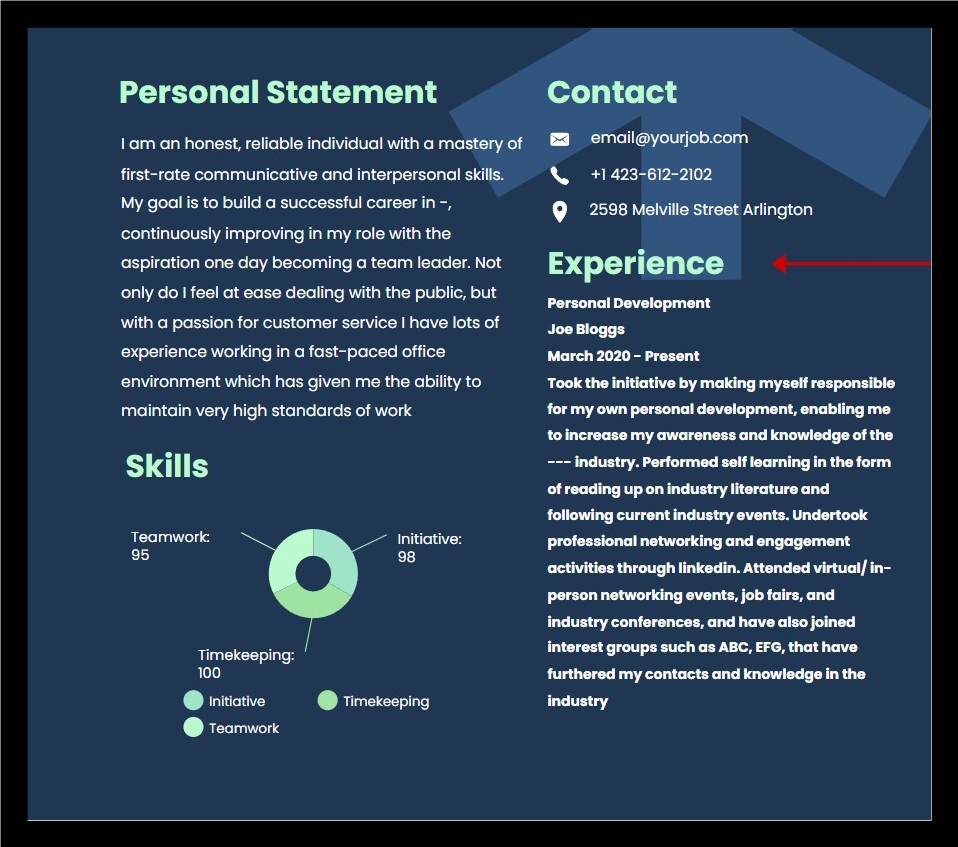
Remember that effective interviewing is not only about providing the interviewer with shining workplace examples of times where you’ve saved the organisation 5% here, or have increased customer satisfaction by 10% there. In a very basic sense, it simply revolves around the ability to have effective conversations with your interviewer, and in this situation, that means having something good to say for yourself even though you may lack the experience sought after for the role itself. The good news here is that there are all sorts of creative ways you can do this in the instances where you are unemployed or have had long gaps in your work history
As we can see from the example here, there is nothing stopping you from creating your own employment history listings on a C.V or resume to show just how proactive you’ve been when it comes to pursuing your career and personal development goals. This can be a shrewd tactic that resonates well with employers, allowing you to fill out an employment history section with a listing where it would otherwise be completely blank. Even though you lack the experience they may desire, by taking the initiative to dazzle them with personal or career development based examples like this, it will show them you’ve not just been sitting idly around, and that you have the capacity to take the initiative when it comes to your own career development…a highly desirable trait that can put you right up there in the running for any role!
Example
‘I’ve created a personal blog with the purpose of encouraging those who are out of work to keep their skills up to date, providing advice on how to identify skills gaps and giving practical advice and support to both job seekers and those in employment alike. I update my blog posts weekly, actively seeking and responding to patron feedback and suggestions, and this has helped me make improvements to my work, such as a great links section that I’ve recently added, giving those looking to network in the —— industry the means to do so.
On top of this, I’ve also included some expert examples from my own work portfolio which I’ve had some great feedback on, and that I’d be delighted to share with you too! Overall, taking the initiative to create my own blog has not only allowed me to keep my industry skills current, but has also been a great way for me to expand my industry knowledge, enabling both myself and countless others to stay up to date with the latest industry trends!
Starting your own blog posting is just one way of showing an employer of how capable you are when it comes to taking the initiative. There are many other different ways that initiative can be conveyed through examples like the following:
Example
‘I coordinated logistics for weekly family events such as setting up tables, arranging supplies, and scheduling activities. This has helped me develop important skills over the years, such as task prioritization, effective resource allocation, and impeccable time management‘.
Example
‘I am highly proactive when it comes to the use of my time, and one of the most important ways I choose to spend it is by performing regular physical exercise. Activities such as jogging and gym workouts have improved my physical fitness levels, giving me the capacity to lift heavy objects of up to 100lbs +. Practicing yoga has enhanced my mood and mental well-being, increasing my productivity levels and helping me go about my daily tasks with an unmatched zeal. I also feel that as a prospective employee, the added advantage of being physically healthy is that it comes with a reduced risk of absenteeism’.
EMPLOYERS LOOK FOR CANDIDATES WHO GIVE THEM GREAT CONVERSATIONS


This is the fundamental basis for any good rapport building
It’s true that interviewers will connect with their candidates in different ways. Some may be more focused on the questions themselves – these types of interviewers will take a more formal approach and will be less inclined to make conversation, whereas others will be quite receptive and engaging and ready to make conversation with you – (most interviewers will fall into this latter category)
Having great conversations partly depends on the luck of the draw!
In the first instance, to some extent the ability to have a great conversation with your interviewer relies somewhat on luck. That’s because different people merge better with different types of personalities than others. For this reason, how well you are able to make conversation with your interviewer will at least partly depend on the person you are speaking with. If you’re lucky enough to get a person you can easily bond with, you’ll naturally find it easier to start up a great conversation and establish a common ground with them
Having great conversations
- the first instance, the ability to have a great conversation with your interviewer does rely somewhat on luck. That’s because as we’ve just stated, as individuals well each find it easier to merge with certain types of personalities more than others. For this reason, if you’re lucky enough to get a person you bond well with, you’ll naturally find it easier to start up a great conversation and establish a common ground with them
- This leads onto the second point when it comes to having great conversations – because as a generalization, standard interviewing advice is that you should try to read your interviewer, taking a careful note of their tone and demeanour, and doing your best to match your own with theirs. This is said to give you the best chance of striking the right balance between conversation and interview focus, enabling you to give great answers, while establishing a common ground and hopefully building a great rapport with your interviewer at the same time
- Rehearse! Remember that there’s nothing from stopping you from pre-rehearsing things you want say. This can be a highly effective strategy when it comes to having great conversations, giving you increased confidence and direction that you would otherwise lack. Just like the concept of a self-introduction, writing out and practicing the opening of a conversation can be incredibly beneficial before you go for the actual interview itself, especially if you’re not used to initiating conversations, or lack the charisma to talk naturally about things when meeting new people for the first time. Just remember to practice beforehand so you don’t sound too scripted! Also, it’s important to remember not to overdo your scripting either – focus only on the conversation opening…from there, you’ll find that things will flow naturally and the conversation will start to take it’s a course of its own. For more information on how to compose and rehearse some great conversation openers that are sure make all the difference in your next interview, please visit the following sections
Interview professional presents – great conversation openers
Self introductions
Interview Professional’s 3 most Effective Rehearsal techniques for Interviewing
- When it comes to having great conversations, the last piece of advice may in some instances seem to run somewhat contrary to the second, and although it may sound generic, it’s very, very, simple. Find a style that works best for you! Once you’re comfortable enough to talk openly in your interviews and can incorporate your own individual style into things, you’ll notice a huge difference in how your conversations go. From there, it’s only a matter of time until you get the type of job you’re looking for. Remember that the more interview practice you get in, the easier having great conversations with your interviewers will become!
Lastly, it’s important to keep in mind that the best points to make conversation are at the beginning and end of an interview. That’s because during the main parts of it, your interviewer will be trying to ask you questions and will be focused on evaluating your answers to see what kind of candidate you are
When is the beginning and end of an interview?
The beginning of the interview starts from the time you first meet the interviewer, and is normally construed as going all the way up to the first few opening questions the interviewer asks. That’s because the first few questions the interviewer asks are normally warm up questions designed to put you at ease; during that time the interviewer is still assessing you, but has not started asking any serious questions yet. That’s what makes the beginning of an interview the start establishing a great rapport with your interviewer
The end of the interview usually culminates at the point at which the interviewer asks if you have any questions for them. Again, while they will still be assessing you, this part of the interview is designed to give you the opportunity to learn anything you want to know about the company, and as such, provides another opportunity to make conversation as the interview draws to a close
How the start of a great conversation might look
Example
Interviewer – ‘Good afternoon’.
Candidate – ‘Good afternoon, it’s great to meet you’.
Candidate – ‘I’ve got to say, I’m really thrilled to be here today. This building looks even better than it did when I googled it online’.
Interviewer – ‘Yes, we’re fortunate to work in such lovely surroundings, this way please, we’ll be interviewing through here today’.
Candidate – ‘It was a lot easier to travel here than I thought it would be too. I got here 45 minutes early, so I thought I’d take the time to walk around and get to know the area. It’s lovely. There are lots of nice shops and a really nice park close by. I think that if I worked in this area I’d always be there on my time off. I love the park, it’s one of my favourite things to do, I find it’s such a great way to relax and clear my mind. I think I might need to come down to your offices just so I can visit it more often…’
Interviewer – ‘Yes, it’s a lovely park, we always have the summer music festival there’.
Candidate – ‘I absolutely love the festivals here, they’re one of the most enjoyable things about living in this city. I’ve never been to that one before though, I’ll definitely put it on my list… What about the nature festival, have you ever been to that? It’s held by the beachfront every year’.
Interviewer – ‘Yes, I think I have. It’s really nice’
Candidate – ‘They have some magnificent floral displays there; I usually buy one each year’.
Interviewer – ‘Yes, someone gave me one as a gift once, you’re right, they are really lovely’.
Interviewer – ‘Here we are, if you’d like to have a seat here, we can begin…’
EMPLOYERS ARE LOOKING FOR ENTHUSIASM
Employers want you to be enthusiastic when you interview for a role with them. The great thing about this particular trait is that it’s easy to convey, and is often something an interviewer is specifically instructed to look for, but even when it’s not, it’s still one of the unspoken qualities your interviewer will always intuitively pick up on over the course of the interview itself

We’ve just noted that the great thing about this quality is that as a candidate it’s very easy for you to convey. Going into the interview with an enthusiastic approach and speaking about past experiences and about past employers in an enthusiastic and upbeat way shows your interviewer not only that you are interested in the role itself, but also subtly conveys to them that you are comfortable with the duties associated with that role too. Most important of all, genuine enthusiasm is a quality that will endear you to most different types of people, not only helping make your conversations go a lot more smoothly, but ultimately, making it easier for you to get them to buy into the things you have to say. On the whole, genuine enthusiasm is a trait that comes over particularly well with employers and interviewers, that’s why we recommend it as one of the main areas to focus on in your next upcoming interview
Enthusiasm can be conveyed in numerous different types of ways – through your overall demeanour, as well as through the gestures, verbal nods, and mannerisms you employ too. When we consider this trait and the situations where it has the biggest impacts though, positive language is one of the most effective means you’ll have at your disposal to convey this in any role. That’s why next, we’ll take a look at some of the most effective examples of positive language usage

Most positive wording is very basic and simple, but can have a huge effect on how the interviewer perceives you. Let’s start with something simple
Neutral. ‘Thanks for inviting me to come along and meet with you today, I’m happy to be here and looking forward to talking with you about why I believe I’m the right candidate for this role’.
Enthusiastic. ‘Thanks for inviting me to come along today, I’m delighted to be here and I’m really looking forward to talking with you about why I believe I’m the perfect candidate for this role’.
When we are looking to convey enthusiasm through language – what we are really talking
about is nothing more than an extenuation of positive language. Here we consider a brief introduction leading into an example, and as we can see, one introduction is much more effective than the other
Neural. ‘Getting results for my clients is very important to me, and I’ll always make every effort to do so. An example I can give you of this…’
Enthusiastic. ‘I put results at the heart of everything that I do, and I’m always there for my clients. That’s why I’ll always go the extra mile for them to get the outcome they want. An example I can give you of a time I did this was when…’
Next, we see the candidate giving an example of the actions they have taken on behalf of a client; as we can see, in one example the wording is a lot more effective than in the other

Neural. ‘An example I can give you of a time I have taken effective action on behalf of a client was when I liaised with our accounts department to get archived financial information no longer available on their account that my client needed for tax purposes. Obtaining such information was hard to do, but I made sure I listened to my client and noted down exactly what they needed, then I relayed their precise requirements to our accounts team, and continued to follow up with them until my client got exactly what they needed’.
Enthusiastic. ‘I have a great example for you of a time where I have taken an effective action on behalf of a client. A valued client of mine needed past financial information for tax purposes from so many years back that it was no longer on their account and had been archived. Obtaining such information was hard to do, but I was happy to go out of my way to ensure they got exactly what they wanted. I listened to my client and noted down exactly what they asked, then I relayed their precise requirements to our accounts team, and continued to follow through with them until my client got exactly what they needed. Doing so ensured my client was ecstatic when I came through for them, which strengthened the relationship I enjoyed with them even further’.
The same principle of positive language can be used when covering negative aspects too. While you should always avoid introducing negative topics in the interview yourself, don’t be afraid to cover negative aspects if directly asked by the interviewer, because with the tool of positive language at your disposal, you have nothing to worry about!
It’s important you come across as open and transparent with your interviewer, that’s why wording negative aspects with positive language is a highly effective tactic that will help you deal with challenging questions constructively and score you some big points in your next interview
Next, we see two different examples of an answer a candidate gives when being directly asked a negatively worded question about a time where they’ve experienced a setback at work. While the word choice in these examples is almost identical, in the second response, we can see the candidate using positive language to embellish the details and give a more positive and constructive overall answer
Neutral. ‘My team and I were working to a tight deadline on a project that needed to be finished within a 4-month deadline. It was a very challenging assignment that involved implementing a framework for a new online customer account portal on behalf of a client and was an important project not only to my team but to our company as a whole. Unfortunately, there were some unforeseen problems at the last minute which meant we didn’t get it completed on time. This was a setback that left all of us really disappointed, but we recovered well to deliver on this the following month’.
Constructive. ‘ My team and I were working to a tight deadline on an important project that needed to be finished within a 4-month deadline. It was a very challenging assignment that involved implementing a framework for a new online customer account portal on behalf of a valued client and was an important project not only to my team but to our company as a whole. Unfortunately, there were some unforeseen problems at the last minute, which meant we didn’t get it completed on time. This was a setback which made us all really disappointed, but we recovered well to deliver on this the following month. This was an experience that not only made me stronger and more resilient, but that also made me appreciate the team I had beside me and in spite of the setback, we were all really proud when our client got in touch to personally thank us for the really great work we’d done upon the projects completion’.
EMPLOYERS WILL OFTEN RESPOND WELL TO DIFFERENT TYPES OF DEMEANOURS



Employers want someone they know who will get the job done
When applying for a job, there are certain things that an interviewer will already take for granted about you. These are traits that they will already expect a candidate to have. An example of this might be something like intelligence. (As we are all naturally intelligent anyway, when interviewing for most types of roles, this is a trait interviewers will naturally assume most candidates already possess).
Saying you are a hard worker can be another good example – we naturally expect people to work hard in their jobs anyway, so emphasizing this in an interview can often come across as cliché
Different interviewers will respond differently to different types of personalities



For example, in roles that involve danger, emergency situations, or responsibility for managing and delegating large amounts of resources and people, interviewers may be drawn to candidates who have a natural seriousness about their demeanour that reassures them about that candidate’s ability to perform the role in question
A more serious approach can often help to highlight qualities and core competencies such as results oriented, Leadership Ability, Initiative, and Ambition
Understanding how interviewers might respond to different types of personalities can be a very useful thing indeed – that’s because everyone has a different approach when it comes to how to take on the challenge of the interview, and whereas a trait like enthusiasm tends to be readily apparent no matter who you are speaking with, when it comes to the seriousness of your approach, how another interprets this can often come down to the person in question, as such, it tends to be a much more subjective trait overall. With this in mind, it’s never advisable to pretend to be someone you’re not, especially in an interview – that’s why you should play to your strengths. If you’re cheerful, be cheerful. If you’re inquisitive, be inquisitive
When all things are considered though, understanding how an interviewer might respond to different types of personalities can nevertheless be a very useful thing indeed – and having a seriousness that permeates our approach can be a highly effective trait in an interview, especially when applying for certain types of roles
As a trait, seriousness is all about demeanour. It’s in the way you project yourself and in the way you talk about your prior roles, duties, and responsibilities. Keeping in mind that this is normally one of the more subjective traits, let’s look at how this might be portrayed in an interview
Example – Neutral demeanour
Interviewer – ‘Can you tell me about the duties you currently perform’.
Candidate – ‘There are five main types of pharmaceutical products we currently manufacture. All of these are in tablet form, and I am directly responsible for manufacturing each one’.
Candidate – ‘My primary duty involves me working with a Rotary Tablet Press. This marvellous piece of machinery allows me to produce tablets in reasonably large quantities, and there are a variety of different products and ingredients I use for each medicine I make, that’s why having a strong familiarization with each one is essential. I’m also responsible for configuring the machine based on the type of medicine I’m making. This involves me calibrating the settings and timings for each batch, then from there, I prepare the mix of active ingredients and weigh the exact dosages in precise amounts. Once I’ve configured the machine and loaded the ingredients, I check my work, then recheck it again. From there, I have a member of the senior production team triple check my work before any production batch is started’.
Candidate – ‘Once the process is finished, I then load the tablets into a canister and take them over to a conveyer in the next area where they are packaged. Keeping the equipment clean and sterile is the other main part of my role, and it is equally important, if not more so, than any of the other duties I perform, so it goes without saying that I put all of my effort into it too! I take great pride in every single one of the duties I perform, and I feel I’m blessed to have a job that I really love to do’.
Example – Serious demeanour
Interviewer – ‘Can you tell me about the duties you currently perform’.
Candidate – ‘There are there five main types of pharmaceutical products we currently manufacture. All of these are in tablet form, and I am directly responsible for manufacturing each one. I think the most important thing you should know about my duties though is that each product I manufacture is a valuable resource that enables the public to access vital medicinal aid when they need it most’.
Candidate – ‘My primary duty involves me working with a Rotary Tablet Press. This marvellous piece of machinery allows me to produce tablets in reasonably large quantities, and there are a variety of different products and ingredients I use for each medicine I make, that’s why having a strong familiarization with each one is essential. I’m also responsible for configuring the machine based on the type of medicine I’m making. This involves me calibrating its settings and the timings for each batch. Such duties allow for no mistakes whatsoever. That means preparing the mix of active ingredients and weighing the exact dosages in precise amounts. It’s also why I don’t let anything distract or interrupt me while I’m working. Once I’ve configured the machine and loaded the ingredients, I check my work, then recheck it again. From there, I have a member of the senior production team triple check it before any production batch is started’.
Candidate – ‘From there, I monitor the process all the way through to completion, and great attention to detail is required to do this. Once the process is finished, I load the tablets into a canister and then take them over to a conveyer in the next room so they can be packaged. Keeping the equipment clean and sterile is the other main part of my role, and it is equally important, if not more so, than any of the other duties I perform, so it goes without saying that I put all of my effort into it too! I take great pride in every single one of the duties I perform, and I feel I’m blessed to have a job that really I love to do’.
Comparing the examples here, we can notice subtle nuisances and differences in the language between the two
There are many different aspects that comprise your demeanour and how an interviewer will perceive it beyond the scope of language you use, with your body language, mannerisms, and even the extent of conversation you’ve held with the interviewer up to that point all coming into play. Just remember that ultimately there is no such thing as a right or wrong demeanour, and while it can be useful to have an understanding of how interviewers might perceive different types of personalities (such as the ones outlined here), keep in mind that your demeanour is an innate part of your personality which is yours and yours alone – and that playing to your strengths in the first instance will always give you the best chance of performing well in an interview – this will always be your first and best option (as opposed to trying to be someone you’re not)
EMPLOYERS ARE HIGHLY IMPRESSED WHEN THEIR CANDIDATES EDUCATE THEM
For an employer, there’s nothing more reassuring about knowing their making the right hiring decision than when they encounter a candidate who is able to turn things around and educate them during the interview itself. Most candidates are so focused on answering the interviewer’s questions, that they never have the prescience of mind to take things a step further and try to impart some of their own knowledge back into the interview. This is something that will certainly resonate well with employers and score you some big points when done effectively in any interview
How can I go about doing this?
There is no right or wrong way to go about doing this. It simply depends on the conversion you find yourself having at the time.
You could go into your interview planning to impart a specific thing pertaining to the industry you work in – this would certainly make it easier to work into the conversation. Alternatively, you could go into your interview planning to impart something that’s non-related to the industry. Either way, both are great ways to ensure an employer will find the conversation they have with you one they will remember
Example – non industry related
If you wanted to emphasise a specific competency, like how well you pay attention to detail, or perhaps showcase other skills like creative thinking, reliability, taking the initiative, reading comprehension, or researching, you could start off a conversation like this
‘I pay great attention to detail in everything I do. This is a philosophy I apply not only to my work life, but to my personal life too, and it’s one of the reasons I believe I’d have no problem handling the duties this role requires. For instance, one of the things I’m paying really close attention to nowadays is my energy bills. Every time I get an energy statement through, I read over it very carefully. There’s a lot of information on these statements, and they confuse a lot of people…and it’s only because I’ve been paying such close attention to them that I can let you in on a little secret. If you see your usage outlined on your bill but can’t understand the fees you’ve been charged, there is a way you can actually work out what your usage is. If you’re calculating your electricity, get the number of kilowatts and enter it into your calculator. If you’re calculating the gas, your usage is shown in units, so you first need to convert it to kilowatts. The easiest way to do this is to remember that there are approximately 11 kilowatts for each unit, so simply multiply the number of units by 11. From there, you need to get your tariff rate, and it’s how you enter this number into your calculation that’s important’.
‘You need to enter a zero then a decimal point, then the first four numbers of the tariff figure without any decimal points’.
Like so:
Units used, 200 kilowatts
Tariff price 35.147 pence per kilowatt
200 x 0.3514 = £70.28
‘Also, there is a standing charge applied to each meter in your house, and this will also be indicated on the bill too’.
‘This is charged to your account per day. So, get the price from your bill, then if your calculator has a date calculation mode, use this first to get the number of days you are calculating this for. For instance, the 1st of January, to the 28th of February comes to 58 days’.
‘Now that you know the number of days, do the calculation in exactly the same way’.
Number of days = 58
Standing charge = 41.568 pence per day
58 x 0.4156 = £24.10
Then, simply add the two figures together to get your energy bill for that given period
In this case, 200 kilowatts used over 58 days comes to the following £70.28 + £24.10 = £94.38
Another way you could give the interviewer an example is by linking this with something relevant to the role itself
Example – Industry related
‘Paying great attention to detail is one of my strongest traits. To give you just one example of how I apply this in my work related duties would be the way that I revise for and proofread important material. Whenever I’m sending out a document to a customer, or if I’m sending out a memorandum to another colleague or department in my office, I’ve come to find that the best way to proofread for mistakes is to first read the document over silently first, then, to read it back fully out aloud. This method makes it much easier to pick out errors and always ensures my work is top quality’.
There are many other important qualities and competencies that an employer will look for in an interview – these will be based on the industry and on the role in question. Different roles will necessitate different qualities, that’s why we always advise you to refer to the job description in the first instance so you can get the best indication as to what these might be. Interview professional has analysed a cross-section of numerous competencies across various industries and identified 6 key skills and competencies we believe are most commonly sought after by the employers of today